Showing posts with label Bugnini. Show all posts

Sunday, August 22, 2010

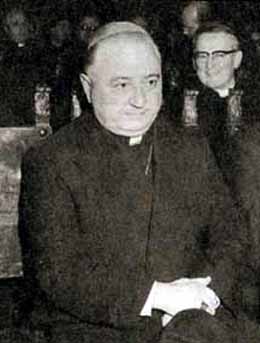
Annibale Bugnini, Novus Ordo Architect, was a Mason After All, a Vatican Official Assures


Share/Bookmark
From "The End of One Mystery," Inside the Vatican, by the editor (July 19, 2009):

Conversation between Robert Moynihan (editor of Inside the Vatican) and an unnamed Vatican official:

"Some are thoughtless. Some are persuaded the Church should be changed. Some just flow with the tide. Some are motivated by money. And then there are those who serve other masters. That was the case with Bugnini..."

I was startled. Not because of what he said, because it is an old allegation, but because of the way he said it, as if it was something settled, beyond discussion.

"Of course, I have heard that," I said, "but why do you say it so bluntly, as if it were certain? I thought it was just an allegation?"

"It is certain," he said. "At least, as certain as anything can be in this world. He went to a meeting in the Secretariat of State, with his briefcase. It was in 1975. Later that evening, when everyone had gone home, a monsignor found the briefcase Bugnini had left behind. The monsignor decided to open it to see who the owner was. And when he opened it, he found letters inside addressed to Bugnini, as to a brother, from the Grand Master of Italian Freemasonry..."

"But could those letters have been forgeries?" I asked. "Could someone have opened the briefcase, seen it was Bugnini's, and then slipped these false documents inside, to frame him?"

"Well, theoretically, I suppose, that is possible. [Note to readers: Bugnini himself always said the allegations were false, that he was never a freemason, and that the charges were made against him by disgruntled conservatives who opposed the work he had done on the liturgy.] But Paul VI, at least, didn't think so. When the evidence was brought to him, he came to the conclusion that Bugnini needed to be removed immediately from his post. Bugnini was made the papal nuncio in Iran. After more than 25 years as the head of the liturgical reform, he was abruptly fired and sent to a country where there are hardly any Catholics at all. It was a type of banishment.

Cf. "Was Bugnini a Mason?" in Tradition in Action.

Monday, June 21, 2010

The Masters of the Crisis: Freemasonry


Share/Bookmark
From Plinio Correa de Oliveira, Revolution and Counter-Revolution, pp. 37-9:
Online Source: www.tfp.org

The Agents of the Revolution: Freemasonry and Other Secret Forces
Since we are studying the driving forces of the Revolution, we must say a word about its agents.
We do not believe that the mere dynamism of the passions and errors of men could coordinate such diverse means to achieve a single end, namely, the victory of the Revolution.

The production of a process as consistent and continuous as that of the Revolution amid the thousand vicissitudes of centuries fraught with surprises of every kind seems impossible to us without the action of successive generations of extraordinarily intelligent and powerful conspirators. To think that the Revolution could have reached its present state in the absence of such conspirators is like believing that hundreds of letters thrown out a window could arrange themselves on the ground to spell out a literary piece, Carducci's "Ode to Satan," for instance.

Heretofore, the driving forces of the Revolution have been manipulated by most sagacious agents, who have used them as means for carrying out the revolutionary process.

Generally speaking, one can classify as agents of the Revolution all the sects - whatever their nature - engendered by it, from its origin to our days, to disseminate its thought or to concatenate its plots. The master sect, however, around which all the others are organized as mere auxiliaries - sometimes consciously and other times not - is Freemasonry, as clearly follows from the pontifical documents, especially Leo XIII's encyclical Humanum genus, of April 20, 1884.

The success of these conspirators, and particularly Freemasonry, is due not only to their indisputable capacity to organize and conspire, but also to their clear understanding of the Revolution's profound essence and of the use of natural laws-the laws of politics, sociology, psychology, art, economics, and so forth - to advance the attaining of their goals.

In this way, the agents of chaos and subversion are like a scientist who, instead of merely relying on his own strength, studies and activates natural forces a thousand times more powerful than he.

Besides largely explaining the success of the Revolution, this provides an important indication for the soldiers of the Counter-Revolution.