Thursday, February 10, 2011
Pope Leo XIII on the Church's Authority over the State in Marriage Legislation
Saturday, August 07, 2010
Hermeneutics of Discontinuity? JP2 vs. Florence on the Revocation of the Mosaic Covenant
It [The Holy Roman Church] firmly believes, professes and teaches that the legal prescriptions of the old Testament or the Mosaic law, which are divided into ceremonies, holy sacrifices and sacraments, because they were instituted to signify something in the future, although they were adequate for the divine cult of that age, once our lord Jesus Christ who was signified by them had come, came to an end and the sacraments of the new Testament had their beginning. Whoever, after the passion, places his hope in the legal prescriptions and submits himself to them as necessary for salvation and as if faith in Christ without them could not save, sins mortally. It does not deny that from Christ's passion until the promulgation of the gospel they could have been retained, provided they were in no way believed to be necessary for salvation. But it asserts that after the promulgation of the gospel they cannot be observed without loss of eternal salvation. Therefore it denounces all who after that time observe circumcision, the sabbath and other legal prescriptions as strangers to the faith of Christ and unable to share in eternal salvation, unless they recoil at some time from these errors. Therefore it strictly orders all who glory in the name of Christian, not to practise circumcision either before or after baptism, since whether or not they place their hope in it, it cannot possibly be observed without loss of eternal salvation...." (Denzinger 712)
Saturday, June 19, 2010
1685th Anniversary of the Opening of the First Council of Nicea
Thursday, June 17, 2010
The Divine Liturgy as the Partaking of Christ's Priesthood Throughout the Ages
Wednesday, June 16, 2010
Modern Political Evils are Due to Our Exclusion of Christ and His Law from Politics and Public Life
Monday, May 10, 2010
498th Anniversary of the Opening of the Fifth Lateran Council
Friday, May 07, 2010
736th Anniversary of the Opening of the Second Council of Lyons (14th Ecumenical): May 7, 1274
Sunday, April 25, 2010
Life of Grace is Heaven already Begun
From Leo XIII, Divinun illud munus (May 9, 1897):
Tuesday, April 20, 2010
126th Anniversary of Humanum genus
Thursday, February 11, 2010
In Memoria S. Gregorii II (Feb. 11), Papae et Confessoris
| Romæ sancti Gregórii Papæ Secúndi, qui Leónis Isáurici impietáti acérrime réstitit, et sanctum Bonifátium ad prædicándum Evangélium in Germániam misit. | At Rome, Pope St. Gregory II, who courageously withstood the impiety of Leo the Isaurian, and sent St. Boniface to preach the Gospel in Germany. |
Wednesday, February 10, 2010
Pope Leo XIII's Summary of Christian Marriage
Sunday, December 13, 2009
464th Anniversary of the Opening of the Council of Trent
(Three-digit numbers refer to Denzinger-Bannwart paragraphs)
SESSION IV (April 8, 1546)
784 They are written here below:
Books of the Old Testament: The five books of Moses, namely, Genesis, Exodus, Leviticus, Numbers, Deuteronomy; Josue, Judges, Ruth, four books of Kings, two of Paralipomenon, the first book of Esdras, and the second which is called Nehemias, Tobias, Judith, Esther, Job, the Psalter of David consisting of 150 psalms, the Proverbs, Ecclesiastes, the canticle of Canticles, Wisdom, Ecclesiasticus, Isaias, Jeremias with Baruch, Ezechiel, Daniel, the twelve minor Prophets, that is Osee, Joel, Amos, Abdias, Jonas, Michaeas, Nahum, Habacuc, Sophonias, Aggaeus, Zacharias, Malachias; two books of the Machabees, the first and the second.
Books of the New Testament: the four Gospels, according to Matthew, Mark, Luke, and John; the Acts of the Apostles, written by Luke the Evangelist, fourteen epistles of Paul the Apostle, to the Romans, to the Corinthians two, to the Galatians, to the Ephesians, to the Philippians, to the Colossians, two to the Thessalonians, two to Timothy, to Titus, to Philemon, to the Hebrews; two of Peter the Apostle, three of John the Apostle, one of the Apostle James, one of the Apostle Jude, and the Apocalypse of John the Apostle. If anyone, however, should not accept the said books as sacred and canonical, entire with all their parts, as they were wont to be read in the Catholic Church, and as they are contained in the old Latin Vulgate edition, and if both knowingly and deliberately he should condemn the aforesaid traditions let him be anathema. Let all, therefore, understand in what order and in what manner the said Synod, after having laid the foundation of the confession of Faith, will proceed, and what testimonies and authorities it will mainly use in confirming dogmas, and in restoring morals in the Church.
The Vulgate Edition of the Bible is Accepted and the Method is Prescribed for the Interpretation of (Sacred) Scripture, etc.*
785 Moreover, the same sacred and holy Synod taking into consideration that no small benefit can accrue to the Church of God, if it be made known which one of all the Latin editions of the sacred books which are in circulation is to be considered authentic, has decided and declares that the said old Vulgate edition, which has been approved by the Church itself through long usage for so many centuries in public lectures, disputations, sermons, and expositions, be considered authentic, and that no one under any pretext whatsoever dare or presume to reject it.
786 Furthermore, in order to curb impudent clever persons, the synod decrees that no one who relies on his own judgment in matters of faith and morals, which pertain to the building up of Christian doctrine, and that no one who distorts the Sacred Scripture according to his own opinions, shall dare to interpret the said Sacred Scripture contrary to that sense which is held by holy mother Church, whose duty it is to judge regarding the true sense and interpretation of holy Scriptures, or even contrary to the unanimous consent of the Fathers, even though interpretations of this kind were never intended to be brought to light. Let those who shall oppose this be reported by their ordinaries and be punished with the penalties prescribed by law . . . . [Then laws are listed concerning the printing and approbation of books, for which among other matters the decree is:] that henceforth the Sacred Scripture, especially the aforesaid old and Vulgate edition, be printed as correctly as possible, and that no one be allowed either to print or cause to be printed any books whatever concerning sacred matters without the name of the author, nor to sell them in the future or even to keep them, unless they have been first examined and approved by the ordinary. . .
Friday, December 11, 2009
Decrees of St. Damasus I (AD 366-384)
Tuesday, December 08, 2009
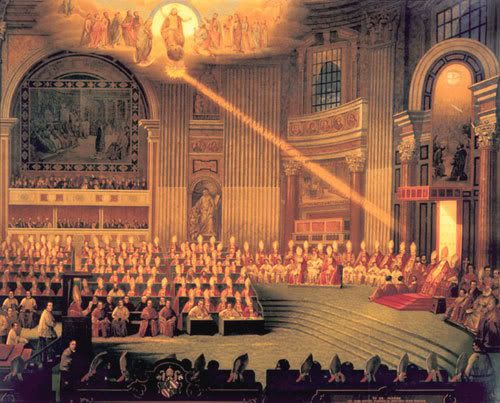
130th Anniversary of the Opening of the Vatican Council
(And the 44th Anniversary of the Closing of the Second Vatican Council)THE VATICAN COUNCIL (1869-1870)
1833 For the fathers of the fourth council of Constantinople, adhering to the ways of the former ones, published this solemn profession: "Our first salvation is to guard the rule of right faith [. . .]. And since the sentiment of our Lord Jesus Christ cannot be passed over when He says: 'Thou art Peter; and upon this rock I will build my church' [Matt. 16:18], these words which were spoken are proven true by actual results, since in the Apostolic See the Catholic religion has always been preserved untainted, and holy doctrine celebrated. Desiring, then, least of all to be separated from the faith and teaching of this [Apostolic See], We hope that We may deserve to be in the one communion which the Apostolic See proclaims,in which the solidarity of the Christian religion is whole and true" *
1834 [cf. n. 171 f.]. Moreover, with the approval of the second council of Lyons, the Greeks have professed, "that the Holy Roman Church holds the highest and the full primacy and pre-eminence over the universal Catholic Church, which it truthfully and humbly professes it has received with plenitude of power from the Lord Himself in blessed Peter, the chief or head of the Apostles, of whom the Roman Pontiff is the successor; and, just as it is bound above others to defend the truth of Faith, so, too, if any questions arise about faith, they should be defined by its judgment" [cf. n.466].
1835 Finally, the Council of Florence has defined: "That the Roman Pontiff is the true vicar of Christ and head of the whole Church and the father and teacher of all Christians; and to it in the blessed Peter has been handed down by the Lord Jesus Christ the full power of feeding, ruling, and guiding the universal Church" [see n.694].
1836 [Argument from the assent of the Church]. To satisfy this pastoral duty, our predecessors always gave tireless attention that the saving doctrine of Christ be spread among all the peoples of the earth, and with equal care they watched that, wherever it was received, it was preserved sound and pure. Therefore, the bishops of the whole world, now individually, now gathered in Synods, following a long custom of the churches and the formula of the ancient rule, referred to this Holy See those dangers particularly which emerged in the affairs of faith, that there especially the damages to faith might be repaired where faith cannot experience a failure. * The Roman Pontiffs, moreover, according as the condition of the times and affairs advised, sometimes by calling ecumenical Councils or by examining the opinion of the Church spread throughout the world; sometimes by particular synods, sometimes by employing other helps which divine Providence supplied, have defined that those matters must be held which with God's help they have recognized as in agreement with Sacred Scripture and apostolic tradition. For, the Holy Spirit was not promised to the successors of Peter that by His revelation they might disclose new doctrine, but that by His help they might guard sacredly the revelation transmitted through the apostles and the deposit of faith, and might faithfully set it forth. Indeed, all the venerable fathers have embraced their apostolic doctrine, and the holy orthodox Doctors have venerated and followed it, knowing full well that the See of St. Peter always remains unimpaired by any error, according to the divine promise of our Lord the Savior made to the chief of His disciples: "I have prayed for thee, that thy faith fail not: and thou, being once converted, confirm thy brethren" [Luke 22:32].
1837 So, this gift of truth and a never failing faith was divinely conferred upon Peter and his successors in this chair, that they might administer their high duty for the salvation of all; that the entire flock of Christ, turned away by them from the poisonous food of error, might be nourished on the sustenance of heavenly doctrine, that with the occasion of schism removed the whole Church might be saved as one, and relying on her foundation might stay firm against the gates of hell.
1838 [Definition of infallibility]. But since in this very age, in which the salutary efficacy of the apostolic duty is especially required, not a few are found who disparage its authority, We deem it most necessary to assert solemnly the prerogative which the Only-begotten Son of God deigned to enjoin with the highest pastoral office.
1839 And so, adhering faithfully to the tradition received from the beginning of the Christian faith, to the glory of God, our Savior, the elevation of the Catholic religion and the salvation of Christian peoples, with the approbation of the sacred Council, We teach and explain that the dogma has been divinely revealed: that the Roman Pontiff, when he speaks ex cathedra, that is, when carrying out the duty of the pastor and teacher of all Christians by virtue of his supreme apostolic authority he defines a doctrine of faith or morals to be held by the universal Church, through the divine assistance promised him in blessed Peter, operates with that infallibility with which the divine Redeemer wished that His church be instructed in defining doctrine on faith and morals; and so such definitions of the Roman Pontiff from himself, but not from the consensus of the Church, are unalterable.
1840 [Canon]. But if anyone presumes to contradict this definition of Ours, which may God forbid: let him be anathema.
Given at Rome in public session, solemnly held in the Vatican Basilica in the year of our Lord one thousand eight hundred and seventy, on the eighteenth day of July, in the twenty-fifth year of Our Pontificate.
In conformity with the original.
Joseph, Bishop of St. Polten Secretary to the Vatican Council.