Wednesday, November 04, 2009

In Festo S. Caroli Borromei (Nov. 4), Acta


Share/Bookmark
Absolutio: Ipsíus píetas et misericórdia nos ádjuvet, qui cum Patre et Spíritu Sancto vivit et regnat in sæcula sæculórum.
R.  Amen.

Absolution:  May his loving-kindness and mercy assist us.  Who, with the Father, and the Holy Ghost, liveth and reigneth, for ever and ever.
R.  Amen.

V.  Jube domne, (Dómine) benedícere.
V.  Vouchsafe, Reverend Father (O Lord), thy blessing.
Benedíctio 4: Deus Pater omnípotens sit nobis propítius et clemens.
R.  Amen.

Benediction 4:  May God the Father Almighty shew us his mercy and pity.
R.  Amen.

Lesson iv

Cárolus, Medioláni nóbili Borromæórum família natus, quanta futúrus esset sanctitáte conspícuus, divína lux super pariéntis matris cubículum noctu corúscans præsignávit.  A puerítia clericáli milítiæ adscríptus, abbatía póstmodum insignítus, patrem admónuit ne réditus in rem familiárem converteréntur ; quorum ipse nactus administratiónem, quidquid supérerat, expendébat in páuperes.  Adoléscens liberálibus disciplínis Papíæ óperam dedit.  Castitátem ádeo cóluit, ut impudícas étiam mulíeres, ad labefactándam ejus pudicítiam plúries immíssas, invícta constántia fugáverit.  Vigésimum tértium ætátis annum agens, a Pio quarto ejus avúnculo in sacrum cardinálium collégium cooptátus, insígni pietátis ac virtútum ómnium splendóre prælúxit.  Mox ab eódem Mediolanénsis archiepíscopus creátus, in eo plúrimam óperam adhíbuit, ut, juxta sacrosánctum Tridentínum concílium, quod ejus potíssimum sollicitúdine jam tum fúerat absolútum, ecclésiam sibi commíssam compóneret ; atque, ut depravátos plebis suæ mores reformáret, præter iterátam sæpius synodórum celebratiónem, seípsum exímiæ sanctitátis præbuit exémplar.  In profligándis hæréticis e pártibus Rhætórum et Helvetiórum, quorum plúrimos ad christiánam fidem convértit, máxime laborávit.
Charles, of the noble family of Borromeo, was born at Milan.  In foretoken of his holy life, God caused a bright light to shine by night over the chamber where his mother lay in travail.  As soon as his age would allow him, he received the tonsure.  When he was twelve years old, he was made Abbot but reminded his father that the revenues thereof were not be used as mere family property.  His father, to whom the administration of these revenues fell during his son's non-age, still gave them forthwith over to him, and whatever was left over, he gave to the poor.  While he was young he studied letters at Pavia.  He kept his purity thoroughly, so that he scared away the unclean women, of whom many were set upon him, to overthrow his self-control.  In the twenty-third year of his age, his uncle, Pius IV, made him a Cardinal, in which dignity he was a burning and shining light of godliness and all graces before the whole of the Sacred College.  About forty days afterwards the same Pope created him Archbishop of Milan.  As such it was his great desire to order the Church committed to his charge in accordance with the requirements of the most holy Council of Trent, which was in great part by his labours brought to a conclusion.  To raise up the degraded lives of the people, he oftentimes held Synods, but himself set an example of deep godliness.  He worked earnestly to purge the parts about the Alps and borders of Switzerland of heresy, and brought many of the heretics to the Christian faith.
V.  Tu autem, Dómine, miserére nobis.
R.  Deo grátias.
V.  But thou, O Lord, have mercy upon us.
R.  Thanks be to God.

Milan Cathedral
R.  Invéni David servum meum, óleo sancto meo unxi eum : * Manus enim mea auxiliábitur ei.
V.  Nihil profíciet inimícus in eo, et fílius iniquitátis non nocébit ei.
R.  Manus enim mea auxiliábitur ei.
R.  I have found David my servant, with my holy oil have I anointed him. * My hand shall hold him fast.
V.  The enemy shall not be able to do him violence ; the son of wickedness shall not hurt him.
R.  My hand shall hold him fast.

V.  Jube domne, (Dómine) benedícere.
V.  Vouchsafe, Reverend Father (O Lord), thy blessing.
Benedíctio 5: Christus perpétuæ det nobis gáudia vitæ.
R.  Amen.

Benediction 5: May Christ bestow upon us the joys of life eternal.
R.  Amen.

Lesson v

Hujus viri cáritas præcípue enítuit, cum, Uritáno principátu vendíto, prétium univérsum, ad quadragínta aureórum míllia, una die in páuperes erogávit.  Nec minóre pietáte vigínti míllia, quæ sibi fúerant legáta, distríbuit.  Ecclesiásticos provéntus, quibus ab avúnculo copióse fúerat cumulátus, dimísit, nonnúllis reténtis, quibus ad próprios usus et egenórum necessitátes utebátur.  Quo témpore pestis Medioláni grassabátur, domésticam supelléctilem, ne relícto sibi léctulo, in eósdem aléndos cóntulit, super nuda in pósterum tábula decúmbens ; eóque morbo laborántes sédulo invísens, patérno reficiébat afféctu, et Ecclésiæ sacraménta própriis ipse mánibus adminístrans, mirum in modum solabátur.  Humíllimis ínterim précibus reconciliátor accédens, pública supplicatióne indícta, fune sibi ad collum alligáto, nudis pédibus étiam offendículo cruentátis, crucem bájulans, semetípsum pro peccátis pópuli hóstiam ófferens, divínam indignatiónem avértere satagébat.  Ecclesiásticæ libertátis fuit acérrimus propugnátor.  Disciplínæ vero restituéndæ sollícitus, a seditiósis, dum oratióni insísteret, torménti béllici laxáta rota, ígneo glóbulo percússus, divína virtúte servátur illæsus.
Charity was the brightest mark of his life.  His principality of Oria he sold for forty thousand crowns, and gave the whole sum to the poor in one day.  Twenty thousand crowns being left him as a legacy he gave the whole to the poor.  The incomes of the benefices wherewith he had been loaded by his uncle, he spent upon the needs of the poor, except what he used for himself.  When the plague grievously raged in Milan, he gave up to the sick poor the furniture of his own house, even to his own bedding, and thenceforward slept upon the boards.  He constantly visited the sick, cheered them by his fatherly kindness, and wonderfully comforted them, ministering to them with his own hands the Sacraments of the Church.  At the same time he drew near to plead for them with God in lowly entreaty, and ordered a public Procession wherein he walked himself carrying a Cross, with a rope halter round his neck, and his bare feet bleeding from the stones, and fain to turn away the Divine anger by offering himself as a scapegoat for the sins of his people.  He was a stout defender of the freedom of the Church.  But in the Church he was an earnest reformer of discipline, and once, when he was engaged in prayer, some conspirators took a shot at him with a blunderbuss, but, though the ball struck him, the power of God kept him unharmed.
V.  Tu autem, Dómine, miserére nobis.
R.  Deo grátias.
V.  But thou, O Lord, have mercy upon us.
R.  Thanks be to God.

R.  Pósui adjutórium super poténtem, et exaltávi eléctum de plebe mea : * Manus enim mea auxiliábitur ei.
V.  Invéni David servum meum, óleo sancto meo unxi eum.
R.  Manus enim mea auxiliábitur ei.
R.  I have laid help upon one that is mighty, I have exalted one chosen out of the people. *My hand shall hold him fast.
V.  I have found David, my servant, with my holy oil have I anointed him.
R.  My hand shall hold him fast.


V.  Jube domne, (Dómine) benedícere.
V.  Vouchsafe, Reverend Father (O Lord), thy blessing.
Benedíctio 6: Ignem sui amóris accéndat Deus in córdibus nostris.
R.  Amen.

Benediction 6: May God enkindle in our hearts the fire of his holy love.
R.  Amen.

Monday, November 02, 2009

Domingo Bañez, OP (Catholic Encyclopedia Article)


Share/Bookmark

(Originally and more properly VAÑEZ and sometimes, but erroneously, IBAÑEZ).


A Spanish Dominican theologian, b. 29 February, 1528, at Medina del Campo, Old Castile; d. there 22 October, 1604. The qualifying Mondragonensis, attached to his name, seems to be a patronymic after his father John Bañez of Mondragon, Guipuscoa. At fifteen he began to study philosophy at the University of Salamanca. Three years later he took the Dominican habit at St. Stephen's Convent, and made his profession 3 May, 1547. During a year's review of the liberal arts and later, he had the afterwards distinguished Bartolomé Medina as a fellow student. Under such professors as Melchior Cano (1548-51), Diego de Chaves (1551), and Pedro Sotomayor (1550-51) he studied theology, laying the foundations of the erudition and acquiring the acumen which later made him eminent as a theologian and an exponent and defender of Thomistic doctrine. He next began teaching, and under Domingo Soto, as prior and regent, he field various professorships for ten years. He was made master of students, explaining the "Summa" to the younger brethren for five years, and incidentally taking the place, with marked success, of professors who were sick, or who for other reasons were absent from their chairs at the university. In the customary, sometimes competitive, examinations before advancement he is said easily to have carried off all honours. He taught at the Dominican University of Avila from 1561 to 1566. About 1567 he was assigned to a chair of theology at Alcalá, the ancient Complutum. It appears that he was at Salamanca again in 1572 and 1573, but during the four scholastic years 1573-71 he was regent of St. Gregory's Dominican College at Valladolid, a house of higher studies where the best students of the Castilian province were prepared for a scholastic career. Elected Prior of Toro, he went instead to Salamanca to compete for the chair of Durandus, left vacant by Medina's promotion to the chief professorship. He occupied this position from 1577 to 1580. After Medina's death (30 December 1580) he appeared again as competitor for the first chair of the university. The outcome was an academic triumph for Bañez and he was duly installed in his new position amid the acclamations of professors and students. There he laboured for nearly twenty years. His name acquired extraordinary authority, and the leading schools of orthodox Spain referred to him as the proeclarissimum jubar-- "the brightest light" — of their country.

In another way, Bañez in his prime was rendering memorable service to the Church as director and confessor of St. Teresa (1515-82). Her own words mark him as the spiritual adviser who was most relied upon as a guide and helper, both in her interior life and in her heroic work of the Carmelite reform.

"To the Father Master Fra Dominic Bañez, who is now in Valladolid as Rector of the College of St. Gregory, I confessed for six years, and, whenever I had occasion to do so, communicated with him by letter. . . . All that is written and told, she communicated to him, who is the person with whom she has had, and still has, the most frequent communications." (See Life of St. Teresa of Jesus, by herself, tr. by David Lewis, 3d ed., London, 1904, Relation VII, 448, 450.) 

Of the first foundation of the reform, St. Joseph's Monastery at Avila, she wrote that Bañez alone saved it from the destruction resolved upon in an assembly of civil and religious authorities (op. cit., ch. xxxvi, 336 sqq.). He did not then know the saint, but "from that time forth he was one of her most faithful friends, strict and even severe, as became a wise director who had a great saint for his penitent." He testifies, in the process of her beatification that he was firm and sharp with her, while she herself was the more desirous of his counsel the more he humbled her, and the less he seemed to esteem her (op. cit., p., xxxvi). He looked for the proof of her love of God in her truthfulness, obedience, mortification, patience, and charity towards her persecutors, while he avowed that no one was more incredulous than himself as to her visions and revelations. In this his mastery of the spiritual life was shown to be as scientific as it was wholesome and practical.

It was easy enough to praise the writings of St. Teresa and to admit her sanctity after her death. Fra Bañez had no external help in the applause of the many, and he had to judge her book as a theologian and the saint as one of his ordinary penitents. When he wrote, he wrote like a man whose whole life was spent, as he himself tells us, in lecturing and disputing (ibid.).

As the schoolman, the lecturer, and academic disputant, Bañez stands forth as a figure of unprecedented distinction in scholastic Spain. In his time discussion was rife, and disquieting tendencies counter to the beaten paths of Augustine and Thomas manifested themselves. The great controversy, with whose beginnings his name is prominently associated, goes back to a public disputation held early in 1582. Francisco Zumel, of the Order of Mercy, was moderator. Prudentius Montemayor, a Jesuit, argued that Christ did not die freely, and consequently suffered death without merit, if the Father had given him a command to die. Bañez asked what the consequences would have been if the Father had given command not only as to the substance of the act of death, but also as to its circumstances. Prudentius responded that in that case there remained neither liberty nor merit. Louis de Leon, an Augustinian, sided with Prudentius and presently the discussion was taken up by the masters in attendance and carried to the kindred subjects of predestination and justification. Other formal disputations ensued, and strong feeling was manifested. Juan de Santa e Cruz, a Hieronymite, felt constrained to refer the matter to the Inquisition (5 February), and to his deposition he appended sixteen propositions covering the doctrines in controversy. Leon declared that he had only defended the theses for the sake of argument. His chief thought was to prevent them from being qualified as heretical. Notwithstanding these and further admissions, he was forbidden to teach, publicly or privately, the sixteen propositions as reviewed and proscribed.

In 1588, Luis Molina, a Jesuit brought out, at Lisbon, his celebrated "Concordia liberi arbitrii cum gratiæ donis", bearing the censura, or sanction, of a Dominican, Bartolomeu Ferreiro, and dedicated to the Inquisitor General of Portugal, Cardinal Albert of Austria; but a sentiment against its appearance in Spain was aroused on the ground of its favouring some of the interdicted propositions. The cardinal, advised of this, stopped its sale, and requested Bañez and probably some others to examine it. Three months later, Bañez gave his opinion that six of the eleven forbidden propositions appeared in the "Concordia".

Molina was asked to defend himself, and his answers to the objections and to some other observations were added as an appendix, with which, sanctioned anew (25 and 30 August, 1589), the work was permitted to circulate. It was regarded as an epoch-making study, and many Fathers of the Society of Jesus rallied to its defense. From Valladolid where the Jesuit and Dominican schools in 1594 held alternate public disputations for and against its teaching on grace, the contention spread over all Spain. The intervention of the Inquisition was again sought, and by the authority of this high tribunal the litigants were required to present their respective positions and claims, and a number of universities, prelates, and theologians were consulted as to the merits of the strife. The matter was referred however, by the papal nuncio to Rome, 15 August 1594, and all dispute was to cease until a decision was rendered. In the meantime, to offset his Dominican and other critics, Molina brought counter accusations against Bañez and Zumel. The latter submitted his defense in three parts, all fully endorsed by Bañez, 7 July 1595. The Dominican position was set forth about the same time by Bañez and seven of his brethren, each of whom presented a separate answer to the charges. But the presiding officer of the Inquisition desired these eight books to be reduced to one, and Bañez, together with Pedro Herrera and Didacus Alvarez was instructed to do the work. About four months later Alvarez presented their joint product under the title "Apologetica fratrum prædicatorum in provinciâ Hispaniæ sacræ theologiæ professorum, adversus novas quasdam assertiones cujusdam doctoris Ludovici Molinæ nuncupati", published at Madrid, 20 November, 1595. It is noteworthy that this work was signed and ratified by twenty-two masters and professors of theology. To it was added a tract on the intrinsic efficacy of Divine grace. Nearly two years later, 28 October, 1597, Bañez resumed the case in a new summary and petitioned the pope to permit the Dominican schools to take up their teaching again on the disputed questions. This was the "Libellus supplex Clementi VIII oblatus pro impetrandâ immunitate a lege silentii utrique litigantium parti impositâ", published at Salamanca. An answer to the "Libellus" was conveyed in a letter of Cardinal Madruzzi, 25 February, 1598, written in the name of the pope, to the nuncio in Spain:

Inform the Fathers of the Order of Preachers that His Holiness, moderating the prohibition that was made, grants them the faculty freely to teach and discuss, as they did in the past, the subject-matter de auxiliis divinae gratia, et eorum efficaciâ, conformably to the doctrine of St. Thomas; and likewise the Fathers of the Society, that they also may teach and discuss the same subject-matter, always holding, however, to sound Catholic doctrine. (Serry, Hist. Cong. de Aux., I, XXVI.)

This pronouncement practically ended whatever personal participation Bañez had in the famous controversy.

It has been contended that Bañez was at least virtually the founder of present-day Thomism, especially in so far as it includes the theories of physical premotion, the intrinsic efficacy of grace, and predestination irrespective of foreseen merit. To any reader of Bañez it is evident that he would have met such a declaration with a strenuous denial. Fidelity to St. Thomas was his strongest characteristic. "By not so much as a finger-nail's breadth, even in lesser things", he was wont to say, "have I ever departed from the teaching of St. Thomas". He singles out for special animadversion the views in which his professors and associates dissent even lightly from the opinions of the Angelic Doctor. "In and throughout all things, I determined to follow St. Thomas, as he followed the Fathers", was another of his favourite assurances. His zeal for the integrity of Thomistic teaching could brook no doctrinal novelty, particularly if it claimed the sanction of St. Thomas's name. In the voluminous literature of the De Auxiliis and related controversies, the cardinal tenets of Thomism are ascribed by its opponents to a varied origin: The Rev. G. Schneeman, S.J., (Controversiarum de divinæ gratiæ liberique arbitrii Concordiâ initiae progressus, Freiburg im Br., 1881), the Rev. Father De Regnon, S.J. (Bañez et Molina, Paris, 1883) and the Rev. Father Gaudier, S.J. (in the Revue des Sciences Ecclésiastiques, Amiens, 1887, p. 153) are probably the foremost modern writers who designate the Thomists as Bannesians. But against them appears a formidable list of Jesuits of repute who were either Thomists themselves or authorities for other opinions. Francisco Suárez, for instance (Op. omn., XI, ed Vives, Paris, 1886, Opuse., I, Lib. III, De Auxiliis vii), credits Medina with the first intimations of physical premotion and elsewhere (Op. omn., XI, 50; Opusc. I, Lib. I, De Conc.-Dei, xi, n 6) admits that St. Thomas himself once taught it. Toletus* (Comment. in 8 Lib. Aristotelis, Venice, 1573, Lib. II, c. iii, q.8) and Pererius (Pref. to Disquisit. Magicarum Lib. VI, I Ed.) considered as Thomistic the Catechism of the Council of Trent, which was the work (1566) of three Dominican theologians. [For Delrio see Goudin, Philosophia (Civita Vecchia, 1860), IV pt. IV, 392, Disp. 2, q. 3, 2.] The Rev. Victor Frins S.J., gives it as his opinion (S. Thomæ Aq. O.P. doctrina de Cooperatione Dei cum omni naturâ creatâ præsertim liberâ, Responsio ad R.P. Dummermuth O.P., Paris, 1893) that whilst Medina and Pedro Soto (1551) taught physical predetermination, the originator of the theory was Francis Victoria, O.P. (d. 1546). The Dominicans Ferrariensis (1576), Cajetan (1507), and Giovanni Capreolus (d. 1436) are also accredited Thomists in the estimation of such authorities as the Jesuits Becanus* [Summa Theol. Schol. (Mainz, 1612), De Deo, xviii, no 14] and Azorius [Institut. Moral. (Rome, 160-11), Lib. I, xxi, 7], and the theologians of Coimbra (Comment. in 8 libros Phys., Lib. II, q. 13, a. 1). Molina, strangely enough, cites the doctrine of a "certain disciple of St. Thomas" — supposedly Bañez — as differing only in words from the teaching of Scotus, instead of agreeing with that of Aquinas [Concordia (Paris 1876), q. 14, a. 13, Disp. 50]. These striking divergences of opinion of which only a few have been cited would seem to indicate that the attempt to father the Thomistic system on Bañez has failed. [Cf. Defensio Doctrinæ S. Thomæ, A.M. Dummermuth O.P., Louvain and Paris, 1895, also Card. Zigliara, Summa Phil. (Paris, 1898), II, 525.]

The development of Thomistic terminology in the Dominican school was mainly due to the exigencies not only of the stand taken against Molina and the forbidden propositions already mentioned, but of the more important defense against the attacks and aberrations of the Reformers. The "predetermination" and "predefinition" of Bañez and his contemporaries, who included others besides Dominicans, emphasized, on the part of God's knowledge and providence, a priority to, and independence of future free acts, which, in the Catharino-Molinistic theories, seemed to them less clearly to fall under God's causal action. These terms, however, are used by St. Thomas himself. (Comment. de divinis nominibus, Lect. iii.) The words "physical premotion" were meant to exclude, first a merely moral impulse and, secondly, a concurrence of the Divine causality and free will, without the latter's subordination to the First Cause. That such terms, far from doing violence to the teachings of their great leader, are their true expression, has, of course, been an unvaried tenet of the Thomistic school. One of the presiding officers of the Congregation De Auxiliis, Cardinal Madruzzi, speaking of Bañez in this connection, said: "His teaching seems to be deduced from the principles of St. Thomas and to flow wholly from St. Thomas's doctrine, although he differs somewhat in his mode of speaking" (Serry, Hist. Cong. de Aux. appendix, col. 89). It seems but fair to the memory of Bañez that this opinion should ultimately prevail.

As a writer, Bañez is clear, direct and vigorous. Occasionally prolix, he is never dull or inane. He treats a subject lengthily only when it is highly important or manifestly useful. His thought is generally lucidity itself in his pithiest scholastic condensations, nor is it less perspicuous when he adopts a freer and more elegant style in behalf of a wider range of readers. Of copious erudition, he was also keen in logic and profoundly versed in metaphysics, surpassing, in this respect, the ablest of his contemporaries. He evidenced a broad-minded and progressive spirit in placing, at no little expense, a fully equipped printing establishment in the convent of St. Stephen, and in employing for its successful operation the best craftsmen that were then to be had. The list of his works is completed as follows: (1) "Scholastica commentaria in Iam partem angelici doctoris D. Thomæ usque ad 64 qu.", fol. Salamanca, 1584; Venice, 1585, 1602; Douai, 1614; (2) "Scholastica commentaria super cæteras Iae partis quæstiones", fol. Salamanca, 1588; (3) "Scholastica commentaria in IIam IIae, quibus quae ad fidem spem et charitatem spectant, clarissime explicantur usque ad quæst. XLVI", fol. Salamanca, 1584; Venice, 1586; (4) "Scholastica commentaria in IIam IIae quaest. LVII ad LXXVII de jure et justitia decisiones", fol. Salamanca, 1594; 1604, Venice, 1595; Cologne and Douai, 1615; (5) "Relectio de merito et augmento charitatis anno MDLXXXIX Salamanticæ in vigilia pentecostes solemniter pronunciata", Salamanca, 1590, 1627; (6) "Commentaria in quaestiones Aristotelis de greneratione et corruptione", fol. Salamanca, 1585; Venice, 1596; Cologne, 1614; (7) "Institutiones minoris dialecticae and In Aristotelis dialecticam", Cologne, 1618; (8) "Responsio ad quinque quæstiones de efficaciâ divinæ gratiæ", Angelica Library, Rome, manuscript R. l. 9. fol. 272; (9) "Respuesta contra una relación compuesta por los padres de la compañia de Jesus de Valladolid," Medina del Campo 1602, manuscript, Dominican Library, Avila.


Sources:

BAÑEZ, autobiography in preface to Comment. in Iam P., D. Thomae.; QUÉTIF-ECHARD, Scriptores Ord. Praed. Paris 1721) II, 352; TOURON, Hist. des hommes illustres de 1'ordre de S. Dominique (Paris 1743) IV, 750; MANDONNET in Dict. de théol. cath. (Paris 1903), Fasc. X, col. 140; MORGOTT in Kirchenlex. (2d ed., Freiburg 1882), 1, s.v. Bañez; SERRY, Hist. congregationum de auxiliis (Venice, 1740); MEYER, Hist. congregatioum de divinae gratiae auxiliis (Venice, 1740); DUMMERMUTH, S. Thomae ct Doctrin. Praemotionis Physicae (Paris, 1886); GAYRAUD, Thomisme et Molinisme (Toulouse, 1889); BERTHTER in Revue Thomiste for 1893, 87; REGNON, Bannésianisme et Molinisme (Paris 1890); GAYRAUD, Réplique au R.P. Th. de Regnon (Toulouse 1890).

Sunday, November 01, 2009

Garrigou-Lagrange on the Gifts and the Beatitudes


Share/Bookmark
From Three Ages of the Interior Life (available thru ITOPL):


Ch 3: The Spiritual Organism (cont)

ARTICLE IV - THE SEVEN GIFTS OF THE HOLY GHOST (cont)

THE GIFTS OF THE HOLY GHOST ACCORDING TO ST. THOMAS (17)

The holy doctor shows us three things in particular: that the gifts are habitual permanent dispositions (habitus) specifically distinct from the virtues; that the gifts are necessary to salvation; and that they are connected with charity and grow with it. St. Thomas says:

To differentiate the gifts from the virtues, we must be guided by the way Scripture expresses itself, for we find there that the term employed is spirit rather than gift. For thus it is written (Isa. 11:2 f.): "The spirit . . . of wisdom and of understanding. . . shall rest upon Him," and so on: from which words we are clearly given to understand that these seven are there set down as being in us by divine inspiration. Now inspiration denotes motion from without. For it must be noted that in man there is a twofold principle of movement, one within him, namely, the reason; the other extrinsic to him, namely, God, as stated above (Ia IIae, q. 9, a. 4. 6), and also by the Philosopher in the chapter on Good Fortune (Ethic. Eudem.,vii).

Now it is evident that whatever is moved must be proportionate to its mover: and the perfection of the thing moved as such consists in a disposition whereby the thing moved is made proportionate to its mover. Hence the more exalted the mover, the more perfect must be the disposition whereby the movable object is made proportionate to its mover: thus we see that a disciple needs a more perfect disposition in order to receive a higher teaching from his master. Now it is manifest that human virtues perfect man according as it is natural for him to be moved by his reason (18) in his interior and exterior actions. Consequently man needs yet higher perfections, whereby to be disposed to be moved by God. These perfections are called gifts, not only because they are infused by God, but also because by them man is disposed to become amenable to the divine inspiration,(19) according to Isa. I: 5: "The Lord . . . hath opened my ear, and I do not resist; I have not gone back." Even the Philosopher says in the chapter on Good Fortune (Ethic. Eudem., loco cit.) that for those who are moved by divine instinct, there is no need to take counsel according to human reason, but only to follow their inner promptings, since they are moved by a principle higher than human reason. This, then, is what some say, that the gifts perfect man for acts which are higher than acts of virtue.(20)

Thus we see that the gifts of the Holy Ghost are not acts, or actual motions, or passing helps of grace, but rather qualities or permanent infused dispositions (habitus), (21) which render a man promptly docile to divine inspirations. Leo XIII, in the encyclical Divinum illud munus, which we quoted at length a few pages back, placed his approval on this manner of conceiving of the gifts. They dispose man to obey the Holy Ghost promptly, as sails prepare a ship to follow the impulse of a favorable wind. By this passive docility, the gifts help us to produce those excellent works known as the beatitudes.(22) From this point of view, the saints are like great sailing vessels which, under full sail, properly catch the impelling force of the wind. The art of navigation teaches a mariner how and when he may most opportunely spread his sails to profit by a favorable breeze.

This figure is used by our Lord Himself when He says: "The Spirit breatheth where He will; and thou hearest His voice, but thou knowest not whence He cometh and whither He goeth. So is everyone that is born of the Spirit" (23) and is docile to His inspiration. St. Thomas says (24) we do not really know where precisely the wind that blows was formed, or how far it will make itself felt. In the same way, we, do not know where precisely a divine inspiration begins, or to what degree of perfection it would lead us if we were wholly faithful to it. Let us not be like sailing vessels which, because of neglect in noting a favorable wind, have their sails furled when they should be spread.

According to these principles, the great majority of theologians hold with St. Thomas that the gifts are really and specifically distinct from the infused virtues, just as the principles which direct them are distinct: that is, the Holy Ghost and reason illumined by faith. We have here two regulating motions, two different rules that constitute different formal motives. It is a fundamental principle that habits are specified by their object and their formal motive, as sight by color and light, and hearing by sound. The human mode of acting results from the human rule; the superhuman mode results from the superhuman or divine rule, from the inspiration of the Holy Ghost, "modus a mensura causatur." (25) Thus even infused prudence proceeds by discursive deliberation, in which it differs from the gift of counsel, which disposes us to receive a special inspiration of a superdiscursive order.(26) Even infused prudence hesitates, for example, about what answer to give to an indiscreet question so as to avoid a lie and keep a secret; while a special inspiration of the Holy Ghost will enable us to find a proper reply, as Christ told His disciples.(27)

Likewise, while faith adheres simply to revealed truths, the gift of understanding makes us scrutinize their depths, and that of wisdom makes us taste them. The gifts are thus specifically distinct from the virtues.(28)

St. Thomas adds in his Summa (29) a statement that he had not made in his Commentary on the Sentences, namely, that the gifts of the Holy Ghost are necessary to salvation. The Book of Wisdom (7: 28) tells us in fact that: "God loveth none but him that dwelleth with wisdom"; and we read in Ecclesiasticus (I: 28): "He that is without fear (of God), cannot be justified." Wisdom is the highest of the gifts, and fear the lowest.

Moreover, St. Thomas notes that even the infused virtues, both theological and moral, which are adapted to the human mode of our faculties, leave us in a state of inferiority in regard to our supernatural end which should be known in a more lively, more penetrating, more delightful manner, and toward which we ought to advance with greater ardor. (30)

Even when faith is elevated, it remains essentially, imperfect for three reasons: (I) because of the obscurity of its object, which it does not attain immediately, but "through a glass in a dark manner" (I Cor. 13: I2); (2) it attains its object only by multiple dogmatic formulas, whereas God is supremely simple; (3) it attains its object in an abstract manner, by affirmative and negative propositions (componendo et dividendo), whereas, on the contrary, the living God is the light of life, whom we ought to be able to know, not in an abstract manner but in a quasi-experimental manner.(31) Hope shares the imperfection of faith, and so does charity as long as its object is proposed by faith.

With even greater reason, prudence, though infused, is imperfect from the fact that it must have recourse to reasoning, to the search for reasons for acting in order to direct the moral virtues. It frequently hesitates, for example, about a suitable answer to give to an indiscreet question so as to keep a secret and avoid a lie. In certain cases, only a good inspiration would be necessary to do so. The same thing is true when it is a case of efficaciously resisting certain temptations, either subtle, or violent and prolonged.

"Human reason," says St. Thomas, "even when perfected by the theological virtues, does not know all things, or all possible things. Consequently it is unable to avoid folly (stultitia) and other like things. . . . God, however, to whose knowledge and power all things are subject, by His motion safeguards us from all folly, ignorance, dullness of mind, hardness of heart, and the rest. Consequently the gifts of the Holy Ghost, which make us docile to His promptings, are said to be given as remedies for these defects." (32)

In this sense they are necessary to salvation, as sails are on a vessel that it may be responsive to a favorable wind, although it may advance also by means of oars. These two ways of advancing are quite distinct, although they may be united or simultaneous.

"By the theological and moral virtues," says St. Thomas, "man is not so perfected in respect of his last end as not to stand in continual need of being moved by the yet higher promptings of the Holy Ghost." (33) This need is permanent in man; for this reason the gifts are in us a permanent, infused disposition.(34)

We make use of the gifts somewhat as we do of the virtue of obedience in order to receive a superior direction with docility and to act according to this direction; but we do not have this superior inspiration whenever we wish.(35) In this sense by means of the gifts we are passive in regard to the Holy Ghost that we may act under His influence. This will explain more clearly why, like obedience, the gifts are a permanent disposition in the just man.(36)

This great fitness, and even this necessity of the gifts, is better seen if we consider the perfection which each of them gives either to the intellect, or to the will and to the sensible part of the soul, as St. Thomas points out.(37)

The following synopsis explains the statement just made:

We see that those gifts which direct the others are superior; among them the gift of wisdom is the highest because it gives us a quasi experimental knowledge of God, and thereby, a judgment about divine things which is superior even to the penetration of the gift of understanding (which belongs rather to first apprehension than to judgment).

The gift of knowledge corresponds to hope in this sense, that it makes us see the emptiness of created things and of human help, and consequently the necessity of placing our confidence in God in order to attain to the possession of Him. The gift of fear also perfects hope by preserving us from presumption; but it corresponds also to temperance to aid us against temptations.(38) To these seven gifts correspond the beatitudes which are their acts, as St. Thomas so well shows.(39)

Finally, from the necessity of the gifts for salvation it follows that they are connected with charity, according to St. Paul's words to the Romans (5: 5): "The charity of God is poured forth in our hearts by the Holy Ghost, who is given to us." The Holy Ghost does not come to us without His seven gifts, which thus accompany charity and which, consequently, are lost with it by mortal sin.

They thus belong to the spiritual organism of sanctifying grace, which is therefore called "the grace of the virtues and the gifts."(40) Since all the infused virtues grow together like the five fingers of the hand,(41) the same must be said of the seven gifts. Hence we cannot conceive of a Christian having that high degree of charity which is proper to perfection, without at the same time having the gifts of the Holy Ghost in a proportionate degree, although perhaps in him the gifts of understanding and of wisdom may be exercised under a less contemplative and more practical form than in others. This was the case with St. Vincent de Paul and many other saints who were called to devote themselves to their neighbor in the works of the active life.(42)

We shall treat later of docility to the Holy Ghost and of the conditions it demands,(43) but we see even now the value of this spiritual organism, which is eternal life begun in us. This life is more precious than sight, than physical life, than the use of reason, in this sense, that the loss of the use of reason does not deprive the just man of this treasure, which death itself cannot snatch from us. This grace of the virtues and gifts is also more precious than the gift of miracles or of tongues or of prophecy; for these charismata are, so to speak, only exterior, supernatural signs, which can point out the way that leads to God, but cannot unite us to Him as sanctifying grace and charity can.(44)

To see more clearly how the diverse functions of this spiritual organism should be exercised, we must speak of the actual grace necessary to the exercise of the virtues and the gifts.(45)


Footnotes:

17. Cf. St. Thomas, In III Sent., dist. 34 f.; Ia IIae, q.68; IIa IIae, q.8, 9, 19, 45, 52, 121, 139; see his commentators, especially Cajetan and John of St. Thomas, on Ia IIae, q.68.


St. Bonaventure may also be consulted with profit. His doctrine differs on certain secondary points from that of St. Thomas; cf. Breviloquium, Part V, chaps. 5 f., and J. Fr. Bonnefoy, Le Saint-Esprit et ses dons selon saint Bonaventure (Paris: Vrin, 1929), and also art. "Bonaventure," Dict. de spiritualite.

See also Dionysius the Carthusian, De donis Spiritus Sancti (an excellent treatise); J. B. de Saint-Jure, S.J., L'homme spirituel, Part I, chap. 4, "Des sept dons"; L. Lallemant, S.J., La doctrine spirituelle, 4th principle, "La docilite a la conduite du Saint-Esprit." B. Froget, O.P., De l'habitation du Saint-Esprit dans les ames justes (Paris, 1900), pp. 378-424. A. Gardeil, O.P., "Dons du Saint-Esprit," Dict. de theol. cathol., IV, 1728-81; La structure de l'ame et l'experience mystique (Paris, 1927), II, 192-281; Les dons du Saint-Esprit dans les saint dominicains (the introduction particularly), 1903. See several other articles on various gifts in particular by the same theologian in La vie spirituelle, 1932, 1933.
D. Joret, O.P., La contemplation mystique d'apres saint Thomas d'Aquin, 1927, pp. 30-62.
We have also treated this important subject at length in Christian Perfection and Contemplation, chap 5, a.5 f., pp. 271-331. See also La vie spirituelle, November 19, 1932, suppl.: 'Les dons ont-ils un mode humain"; ibid., October, 1933, suppl.: "A propos du mode supra-humain des dons du Saint-Esprit," reproduced in this book, infra, pp. 78-88.

18. In the supernatural order, it is a question of reason enlightened by faith. It is thus, in particular, that infused prudence directs the infused moral virtues.

19. "Secundum ea homo disponitur, ut efficiatur prompte mobilis ab inspira tione divina."

20. See Ia IIae, q.68, a. 1.

21. Ibid., a. 3, and III Sent. D. XXXIV, q. I, a. I.

22. See la IIae, q.68, a. 3: "The gifts of the Holy Ghost are habits whereby man is perfected to obey readily the Holy Ghost." Cf. ibid., q.70, a.2: "The beatitudes are none but perfect works, which, by reason of their perfection, are assigned to the gifts rather than to the virtues."

28 John 3:8.

24. St. Thomas, In Joannem, 3:8.

25. This principle, contained in the commentary of St. Thomas on the Sentences and in his Summa, marks the continuity of these two works. Cf. III,D. XXXIV, q.2, a.1, qc.3; q.3, a.1, qc.1; and Ia IIae, q.68, a.1, a.2 ad rum. See
also Perfection chretienne et contemplation, 7th ed., II, [52]-[64J.

26. See IIa IIae, q.52, a. I ad 1um.

27. Matt. 10: 19.

28. Other serious difficulties would follow the negation of the specific distinction between the virtues and the gifts. We could not explain why certain gifts, such as fear, are not numbered among the virtues, or why Christ had the seven gifts, as Isaias teaches us (II: 2 f.), without having certain infused virtues, such as faith, hope, and penance, which suppose an imperfection.

29. See Ia IIae, q.68, a.2.

30. Ibid.

31. The gift of wisdom makes this possible.

32. Ibid., a.2 ad 3um.

33. Ibid., ad 2um. Some theologians, as Abbe Perriot (Ami du clerge, 1891, p. 391), basing their argument on the text of St. Thomas that we have just quoted, have thought that in his opinion the gifts intervene in every meritorious work. Father Froget, O.P. (De l'habitation du Saint-Esprit dans les ames justes, Part IV, chap. 6, pp. 4°7-14) and Father Gardeil, O.P. (Dict. theol. cath., art. "Dons," col. 1779) have shown that this is not at all the true thought of St. Thomas. To say that the gifts of the Holy Ghost must intervene in every meritorious act, even though it be imperfect (remissus et quantumvis remissus), would be to confound ordinary actual grace with the special inspiration to which the gifts render us docile. In the text which we have just quoted, St. Thomas means that man is not perfected to such a degree by the theological virtues that he does not always need to be inspired by the interior Master (semper not pro-semper), as we say: "I always need this hat," not however from morning until night, or from night until morning. Similarly a medical student not so well instructed that he does not always need the assistance of his master for certain operations. The need we experience is not transitory but permanent; all of which goes to show that the gifts should be not transitory inspirations, like the grace of prophecy, but permanent infused dispositions.

Moreover, it is certain that man can make a supernatural act of faith with a actual grace, without any assistance from the gifts of the Holy Ghost, without penetrating or tasting the mysteries to which he adheres. This is the case with the believer who is in the state of mortal sin, and who, on losing charity, has lost the seven gifts.

But, on the other hand, it is commonly admitted that the gifts of the Holy Ghost frequently influence us in a latent manner without our being aware of it, in order to give our meritorious acts a perfection which they would not have without this influence. In like manner, a favorable breeze facilitates the work of the rowers.

As S . Thomas teaches, Ia IIae, q.68, a.8, the gifts are in this way superior to the used moral virtues. Although the gifts are less elevated than the theological virtues, they bring them an added perfection, that, for example, of penetrating and delighting in the mysteries of faith.

34. See Ia IIae, q.68, a.3.

35. John of St. Thomas, De donis, Disp. 18, a.:z, no. 3 I.

36. St. Thomas (Ia IIae, q.68, a.3) and his commentators, in particular John of St. Thomas, show clearly that it is highly fitting that the gifts should be permanent dispositions in us (habitus) in order to render us habitually docile to the Holy Ghost, who always remains in the just soul, as the moral virtues are permanent dispositions to render the will and the sensible part of the soul habitually docile to the direction of right reason.
If it were otherwise, the organism of the life of grace, which is the greatest of the gifts of God, would remain imperfect. It is not fitting that, according to the plan of Providence, which disposes all things suaviter et fortiter, the organism of the supernatural life in the just soul should be in this respect less perfect than that of the acquired virtues directed by reason. Finally, according to tradition, habitual grace is called "the grace of the virtues and gifts." Cf. St. Thomas, IIIa, q.62, a.2.

37. See Ia IIae, q.68, a.4, and IIa IIae, q.8, a.6.

38. See lIa lIae, q. 141, a. 1 ad 3um.

39. See Ia IIae, q.69, a.3, c. and ad 3um; IIa IIae, q.8, a.7; q.9, a.4; q.45, a.6; q.19,a.12; q.121, a.2; q.139,a.2.
Following St. Augustine, St. Thomas shows that the gift of wisdom corresponds to the beatitude of the peacemakers, for it gives peace and allows the soul possessing it to give it to others, at times even to the most troubled. The gift of understanding corresponds to the beatitude of the clean of heart; for those who possess this cleanness of heart begin here on earth, in a certain way, to see God in all that happens to us. The gift of knowledge, which shows us the gravity of sin, corresponds to the beatitude of those who weep for their sins. The gift of counsel, which inclines the soul to mercy, corresponds to the beatitude of the merciful. The gift of piety, which makes us see in men not rivals, but children of God and our brothers, corresponds to the beatitude of the meek. The gift of fortitude corresponds to that of those who unger and thirst after justice and never become discouraged. Finally, the gift of fear corresponds to the beatitude of the poor in spirit; they possess the holy fear of the Lord, which is the beginning of wisdom.

40. See IIIa, q.62, a. 2: "Whether sacramental grace confers anything in addition to the grace of the virtues and gifts." St. Thomas says here that habitual grace is so called because from it proceed the infused virtues and the gifts, as so many functions of the same organism.

41 See Ia IIae, q.66, a.1.

42 Pursuing the comparison we have already used, we note that among sailing vessels equally responsive to the wind, the brig differs from the schooner; the form and arrangement of the sails vary; certain places one type of sail is better than another. Something similar is found in the order of spiritual navigation toward the port of salvation.

43. Cf. infra, Part III, chap. 23.

44. See Ia IIae, q. III, a.5: "Whether gratia gratum faciens is nobler than gratia gratis data." St. Thomas answers with St. Paul (I Cor. 13: 1) that sanctifying grace, which is inseparable from charity, is far more excellent than graces gratis datae.

45. The theological virtues, which unite us to the Holy Ghost, are superior to the seven gifts, although they receive a new perfection from the gifts; thus a tree is more perfect than its fruit. These virtues are the rule of the gifts, in the sense that the gifts make us penetrate more deeply and taste with greater delight the mysteries to which we adhere by faith; but the immediate rule of the act of the gifts is the special inspiration of the Holy Ghost.

In Festo Omnium Sanctorum (Nov. 1): Sermo


Share/Bookmark Source: www.breviary.net


Sermo sancti Bedæ Venerábilis Presbyteri
The Lesson is taken from the Sermons of St. Venerable Bede the Priest
Sermo 18 de Sanctis

The Church of All Saints in Rome,
in former times the Roman temple dedicated unto all the gods,
and known as the Pantheon

Hódie, dilectíssimi, ómnium Sanctórum sub una solemnitátis lætítia celebrámus festivitátem ; quorum societáte cælum exsúltat, quorum patrocíniis terra lætátur, triúmphis Ecclésia sancta coronátur.  Quorum conféssio quanto in passióne fórtior, tanto est clárior in honóre ; quia, dum crevit pugna, crevit et pugnántium glória, et martyrii triúmphus multíplici passiónum génere adornátur, perque gravióra torménta, gravióra fuére et præmia.  Dum cathólica mater Ecclésia, quæ per totum orbem longe latéque diffúsa est, in ipso cápite suo Christo Jesu edócta est contumélias, cruces et mortem non timére ; magis magísque roboráta, non resisténdo sed perferéndo, univérsis, quos ágmine ínclyto carcer pœnális inclúsit, pari et símili calóre virtútis, ad geréndum certámen, glóriam triumphálem inspirávit.
Dearly beloved : Today we keep holy-day, with one great cry of joy, in memory of all the Saints ; whose presence is a gladness to heaven ; whose prayers are a blessing to earth ; whose victories are the crown of holy Church ; whose testimony is now to be honoured in proportion to the glory imparted to it by the agony which was endured in the giving of it.  For the greater the torment, the richer the reward ; and the fiercer the battle, the brighter the glory of the fighters whose triumph in martyrdom was in this wise adorned with more sufferings.  Our mother the Catholick Church, which is spread far and wide throughout all this planet, hath learnt, from Christ Jesus her Head, to fear neither shame nor cross nor death, but to increase in strength by enduring suffering rather than by resisting it.  Therefore she was able to breathe into each one of that noble band, which persevered under condemnation to suffering, a spirit of courage like unto her own, even the hope of conquest and glory, whereby they were envigorated to persevere manfully in conflict unto the very end.
V.  Tu autem, Dómine, miserére nobis.
R.  Deo grátias.
V.  But thou, O Lord, have mercy upon us.
R.  Thanks be to God.

R.  Præcúrsor Dómini venit, de quo ipse testátur :* Nullus major inter natos mulíerum Joánne Baptísta.
V.  Hic est enim prophéta, et plus quam prophéta, de quo Salvátor ait.
R.  Nullus major inter natos mulíerum Joánne Baptísta.
R.  The Forerunner of the Lord cometh, to whom that Lord himself bare witness, saying : *  Among them that are born of women there hath not risen a greater than John the Baptist.
V.  A Prophet? yea, and much more than a prophet, for this is he of whom the Saviour said.
R.  Among them that are born of women there hath not risen a greater than John the Baptist.

V.  Jube domne, (Dómine) benedícere.
V.  Vouchsafe, Reverend Father (O Lord), thy blessing.
Benedíctio 5: Christus perpétuæ det nobis gáudia vitæ.
R.  Amen.

Benediction 5: May Christ bestow upon us the joys of life eternal.
R.  Amen.

Lesson v

O vere beáta mater Ecclésia, quam sic honor divínæ dignatiónis illúminat, quam vincéntium gloriósus Mártyrum sanguis exórnat, quam inviolátæ confessiónis cándida índuit virgínitas!  Flóribus ejus nec rosæ nec lília desunt.  Certent nunc caríssimi, sínguli ut ad utrósque honóres amplíssimam accípiant dignitátem, corónas vel de virginitáte cándidas vel de passióne purpúreas.  In cæléstibus castris pax et ácies habent flores suos, quibus mílites Christi coronántur.
O truly blessed Mother Church, whom God's mercy doth so illúmine!  Whom the glorious blood of victorious Martyrs doth adorn!  Whom the ínviolate virginity of so many pure souls doth clothe with raiment white and glistening!  Neither roses nor lilies are wanting in thy garlands.  Therefore dearly beloved, let us each one of us strive to attain the goodly crown of one or the other of these dignities, either the glistening whiteness of chastity, or the red dye of suffering.  In the heavenly army both peace and war have chaplets of their own, to crown Christ's soldiers withal.
V.  Tu autem, Dómine, miserére nobis.
R.  Deo grátias.
V.  But thou, O Lord, have mercy upon us.
R.  Thanks be to God.

R.  Isti sunt qui vivéntes in carne, plantavérunt Ecclésiam sánguine suo : * Cálicem Dómini bibérunt, et amíci Dei facti sunt.
V.  In omnem terram exívit sonus eórum, et in fines orbis terræ verba eórum.
R.  Cálicem Dómini bibérunt, et amíci Dei facti sunt.
R.  These are they who whilst yet in the flesh planted the Church in their own blood ; * Who drank of the Lord's Cup, and so are become the friends of God.
V.  Their sound is gone out unto all the lands, and their words unto the ends of the earth.
R.  Who drank of the Lord's Cup, and so are become the friends of God.

V.  Jube domne, (Dómine) benedícere.
V.  Vouchsafe, Reverend Father (O Lord), thy blessing.
Benedíctio 6: Ignem sui amóris accéndat Deus in córdibus nostris.
R.  Amen.

Benediction 6: May God enkindle in our hearts the fire of his holy love.
R.  Amen.

Lesson vi

Dei enim ineffábilis et imménsa bónitas étiam hoc provídit, ut labórum quidem tempus et agónis non exténderet nec longum fáceret aut ætérnum, sed breve et, ut ita dicam, momentáneum : ut in hac brevi et exígua vita agónes essent et labóres, in illa vero quæ ætérna est, corónæ et præmia meritórum ; ut labóres quidem cito finiréntur, meritórum vero præmia sine fine durárent ; ut post hujus mundi ténebras visúri essent candidíssimam lucem, et acceptúri majórem passiónum cunctárum acerbitátibus beatitúdinem, testánte hoc idem Apóstolo, ubi ait : Non sunt condígnæ passiónes hujus témporis ad superventúram glóriam, quæ revelábitur in nobis.
Moreover, the unutterable and infinite goodness of God hath provided this, namely, that the time of working and wrestling is not over-long, much less everlasting, but as it were for a moment.  That is, only in this short and scanty life is there wrestling and working, but the crown and the prize endureth for a life which is eternal.  The work is soon over, but the wage is paid for ever.  And when the night of this world is ended, the Saints see the clearness of the essential light, and receive a blessedness outweighing the pangs of any torment, as testifieth the Apostle Paul : The sufferings of this present time are not worthy to be compared with the glory which shall be revealed in us.
V.  Tu autem, Dómine, miserére nobis.
R.  Deo grátias.
V.  But thou, O Lord, have mercy upon us.
R.  Thanks be to God.

R.  Sancti mei, qui in carne pósiti, certámen habuístis, * Mercédem labóris ego reddam vobis.
V.  Veníte, benedícti Patris mei, percípite regnum.
R.  Mercédem labóris ego reddam vobis.
V.  Glória Patri, et Fílio, et Spirítui Sancto.
R.  Mercédem labóris ego reddam vobis.
R.  O ye my Saints and Righteous Ones, who have conténded valiantly in the flesh,  * I will render you a reward of your labours.
V.  Come ye blessed of my Father, inherit the kingdom.
R.  I will render you a reward of your labours.
V.  Glory be to the Father, and to the Son, and to the Holy Ghost.
R.  I will render you a reward of your labours.

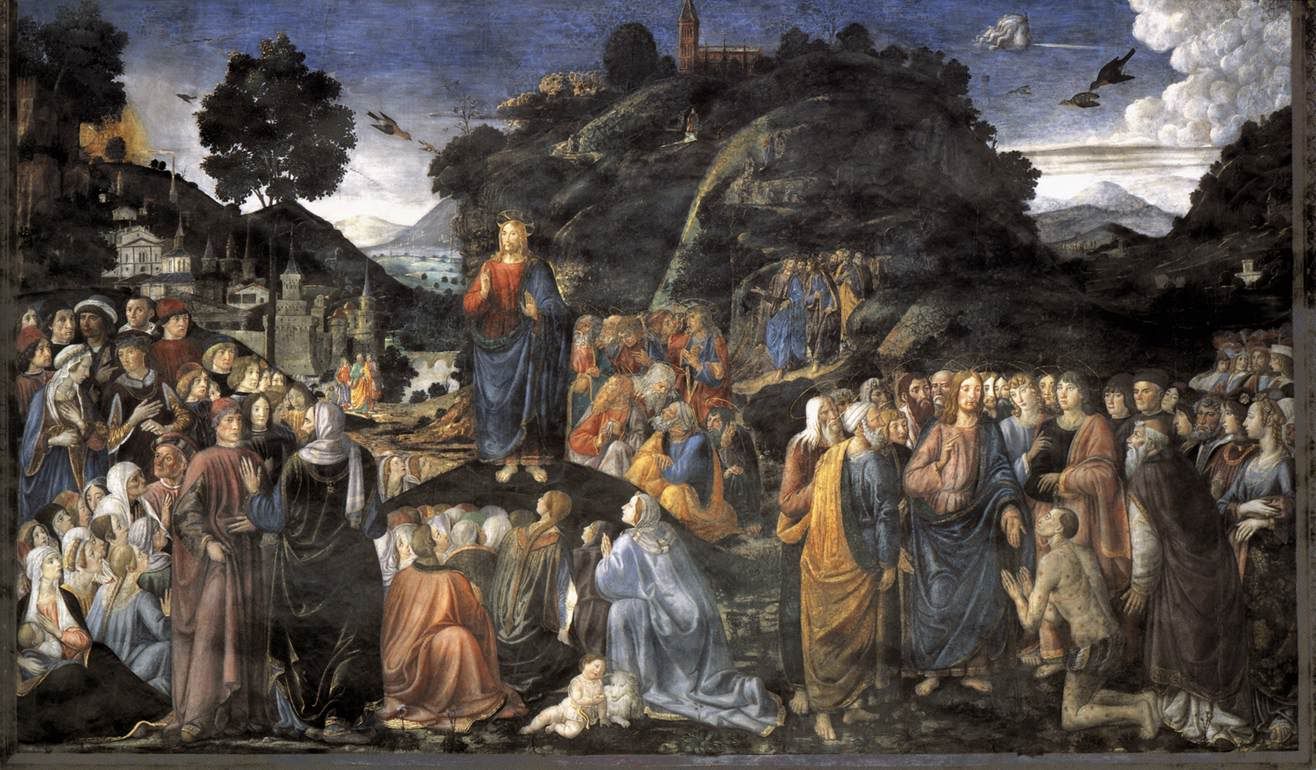
In Festo Omnium Sanctorum (Nov. 1): Evangelium (Graece)


Share/Bookmark
῾Η ἐπὶ τοῦ ῎Ορους ῾Ομιλία
Οἱ μακαρισμοὶ


Ε´\ΙΔΩΝ δὲ τοὺς ὄχλους ἀνέβη εἰς τὸ ὄρος, καὶ καθίσαντος αὐτοῦ προσῆλθον αὐτῷ οἱ μαθηταὶ αὐτοῦ, 2 καὶ ἀνοίξας τὸ στόμα αὐτοῦ ἐδίδασκεν αὐτοὺς λέγων·
3 μακάριοι οἱ πτωχοὶ τῷ πνεύματι, ὅτι αὐτῶν ἐστιν ἡ βασιλεία τῶν οὐρανῶν. 4 μακάριοι οἱ πενθοῦντες, ὅτι αὐτοὶ παρακληθήσονται.
5 μακάριοι οἱ πραεῖς, ὅτι αὐτοὶ κληρονομήσουσι τὴν γῆν.
6 μακάριοι οἱ πεινῶντες καὶ διψῶντες τὴν δικαιοσύνην, ὅτι αὐτοὶ χορτασθήσονται.
7 μακάριοι οἱ ἐλεήμονες, ὅτι αὐτοὶ ἐλεηθήσονται.
8 μακάριοι οἱ καθαροί τῇ καρδίᾳ, ὅτι αὐτοὶ τὸν Θεὸν ὄψονται.
9 μακάριοι οἱ εἰρηνοποιοί, ὅτι αὐτοὶ υἱοὶ Θεοῦ κληθήσονται.
10 μακάριοι οἱ δεδιωγμένοι ἕνεκεν δικαιοσύνης, ὅτι αὐτῶν ἐστιν ἡ βασιλεία τῶν οὐρανῶν.
11 μακάριοί ἐστε ὅταν ὀνειδίσωσιν ὑμᾶς καὶ διώξωσι καὶ εἴπωσι πᾶν πονηρὸν ρῆμα καθ᾿ ὑμῶν ψευδόμενοι ἕνεκεν ἐμοῦ.
12 χαίρετε καὶ ἀγαλλιᾶσθε, ὅτι ὁ μισθὸς ὑμῶν πολὺς ἐν τοῖς οὐρανοῖς· οὕτω γὰρ ἐδίωξαν τοὺς προφήτας τοὺς πρὸ ὑμῶν.

In Festo Omnium Sanctorum (Nov. 1): Homilia


Share/Bookmark
Lesson vii
Léctio sancti Evangélii secúndum MatthæumThe Lesson is taken from the Holy Gospel according to Matthew
Chap. 5, 1-12
In illo témpore : Videns Jesus turbas, ascéndit in montem, et cum sedísset, accessérunt ad eum discípuli ejus.  Et réliqua.
At that time : Jesus, seeing the multitudes, went up into a mountain, and, when he was set, his disciples came unto him.  And so on, and that which followeth.
Homilía sancti Augustíni EpíscopiA Homily by St. Augustine the Bishop
Liber 1 de Sermone Domini in monte, sub initium
Si quæritur quid signíficet mons, bene intellígitur significáre majóra præcépta justítiæ, quia minóra erant quæ Judæis data sunt.  Unus tamen Deus, per sanctos prophétas et fámulos suos, secúndum ordinatíssimam distributiónem témporum, dedit minóra præcépta pópulo quem adhuc timóre alligári oportébat ; et, per Fílium suum, majóra pópulo quem caritáte jam liberári convénerat.  Cum autem minóra minóribus, majóra majóribus dantur, ab eo dantur, qui solus novit congruéntem suis tempóribus géneri humáno exhibére medicínam.
If it be asked what is signified by the mountain, the same may well be understood to indicate the higher and greater commandments of righteousness, since those that were given to the Jews are the lesser.  In an excellent order of dispensations, the one and same God gave, by his servants the holy Prophets, his lesser commandments unto the people that still had need to be bound by fear ; but by his Son he gave the greater to the people whom it was expedient now to set free by love.  But whether it be the lesser to the lesser, or the greater to the greater, all are alike the gift of him who alone knoweth what is in each epoch the seasonable medicine for mankind.
V.  Tu autem, Dómine, miserére nobis.
R.  Deo grátias.
V.  But thou, O Lord, have mercy upon us.
R.  Thanks be to God.
R.  Sint lumbi vestri præcíncti, et lucérnæ ardéntes in mánibus vestris: * Et vos símiles homínibus exspectántibus dóminum suum, quando revertátur a núptiis.
V.  Vigiláte ergo, quia nescítis qua hora Dóminus vester ventúrus sit.
R.  Et vos símiles homínibus exspectántibus dóminum suum, quando revertátur a núptiis.
R.  Let your loins be girded about, and your lights burning: * And be ye yourselves like unto men that wait for their lord when he will return from the wedding.
V.  Watch therefore, for ye know not what hour your Lord doth come.
R.  And be ye yourselves like unto men that wait for their lord when he will return from the wedding.

V.  Jube domne, (Dómine) benedícere.
V.  Vouchsafe, Reverend Father (O Lord), thy blessing.
Benedíctio 8:  Quorum festum cólimus, ipsi intercédant pro nobis ad Dóminum.
R.  Amen.

Benediction 8:  May they whose feast day we are keeping, be our Advocates with God.
R.  Amen.

Lesson viii
Nec mirum est quod dantur præcépta majóra propter regnum cælórum, et minóra data sunt propter regnum terrénum, ab eódem uno Deo, qui fecit cælum et terram.  De hac ergo justítia, quæ major est, per prophetíam dícitur : Justítia tua sicut montes Dei ; et hoc bene signíficat, quod ab uno magístro, solo docéndis tantis rebus idóneo, docétur in monte.  Sedens autem docet, quod pértinet ad dignitátem magistérii.  Et accédunt ad eum discípuli ejus, ut audiéndis illíus verbis hi essent étiam córpore vicinióres, qui præcéptis adimpléndis étiam ánimo propinquábant.  Et apériens os suum docébat eos, dicens.  Ista circumlocútio, qua scríbitur, Et apériens os suum, fortássis, ipsa mora, comméndat aliquánto longiórem futúrum esse sermónem ; nisi forte non vacet quod nunc eum dictum est aperuísse os suum, quod ipse, in lege véteri, aperíre soléret ora prophetárum.
Need we then be surprised that the greater commandments were given for the kingdom of heaven, and the lesser for a commonwealth on earth?  For both are gifts of that one God who is the Maker alike of heaven and of earth.  The higher and greater righteousness is that whereof the Psalmist saith : Thy righteousness standeth like the strong mountains.  And this may be taken mystically to mean that the teaching given from the mountain is from the Master who alone can give teaching of such strength.  In this connection note how the Gospel saith : And when he was set, (which posture indicateth the majesty of his instruction,) his disciples came unto him.  That is, they came nearer in the flesh, to hear those precepts by the fulfilment of which they should be nearer in spirit.  Then saith the Gospel : He opened his mouth, and taught them.  These words : He opened his mouth : appear to be redundant.  It may be that this more extended instruction is adopted on account of the exceptional length of the discourse to follow.  But it may also be that these words are not really redundant, but the pointed declaration that he now opened his own mouth, who under the old Law, had been used to open the mouths of the Prophets.
V.  Tu autem, Dómine, miserére nobis.
R.  Deo grátias.
V.  But thou, O Lord, have mercy upon us.
R.  Thanks be to God.
R.  Média nocte clamor factus est : * Ecce sponsus venit, exíte óbviam ei.
V.  Prudéntes vírgines, aptáte vestras lámpades.
R.  Ecce sponsus venit, exíte óbviam ei.
V.  Glória Patri, et Fílio, et Spirítui Sancto.
R.  Ecce sponsus venit, exíte óbviam ei.
R.  At midnight there was a cry made: * Behold, the Bridegroom cometh, go ye out to meet him.
V.  Trim your lamps, O ye wise Virgins.
R.  Behold, the Bridegroom cometh, go ye out to meet him.
V.  Glory be to the Father, and to the Son, and to the Holy Ghost.
R.  Behold, the Bridegroom cometh, go ye out to meet him.

Monday, October 26, 2009

Last Sunday in October: The Feast of Christ the King (from Vespers)


Share/Bookmark Source: www.breviary.net

Hymnus
Te sæculórum Príncipem,
Te, Christe, Regem Géntium,
Te méntium te córdium
Unum fatémur árbitrum.

Scelésta turba clámitat :
Regnáre Christum nólumus :
Te nos ovántes ómnium
Regem suprémum dícimus.

O Christe, Princeps Pácifer,
Mentes rebélles súbjice:
Tuóque amóre dévios,
Ovíle in unum cóngrega.

Ad hoc cruénta ab árbore
Pendes apértis bráchiis,
Diráque fossum cúspide
Cor igne flagrans éxhibes.

Ad hoc in aris ábderis
Vini dapísque imágine,
Fundens salútem fíliis
Transverberáto péctore.


Te natiónum Præsides
Honóre tollant público,
Colant magístri, júdices,
Leges et artes éxprimant.

Submíssa regum fúlgeant
Tibi dicáta insígnia:
Mitíque sceptro pátriam
Domósque subde cívium.


Jesu tibi sit glória,
Qui sceptra mundi témperas,
Cum Patre, et almo Spíritu,
In sempitérna sæcula.  Amen.
The Hymn
Lord of the ages evermore,
Each nation's King, the wide world o'er,
O Christ, our only Judge thou art,
And Searcher of the mind and heart.

Through Sin with rebel voice maintain,
We will not have this Christ to reign,
Far other, Lord, shall be our cry,
Who hail thee King of kings most High.

O thou eternal Prince of peace,
Subdue man's pride, bid error cease,
Permit not sin to wax o'er-bold,
The strayed bring home within the fold.

For this thou hangedst on the Tree
With arms outstretched in loving plea;
For this thou shewedst forth thy Heart,
On fire with love, pierced by the dart.

And yet that wounded side sheds grace
Forth from the altar's holy place,
Where, veiled 'neath humblest bread and wine,
Abides for man the life divine.

Earth's noblest rulers to thee raise
Their homage due of public praise;
Teachers and judges thee confess;
Art, science, law, thy truth express.

Let kings be fain to dedicate
To thee the emblems of their state;
Rule thou each nation from above,
Rule o'er the people's homes in love.

Proper Doxology
All praise, King Jesu, be to thee,
The Lord of all in majesty;
Whom with the Father we adore,
And Holy Ghost for evermore.  Amen.

V.  Multiplicábitur ejus impérium.
R.  Et pacis non erit finis.
V.  His empire shall be multiplied.
R.  And there shall be peace without end.