Wednesday, August 10, 2011

Quaeritur: How Can You Prove That There Is One God, and Not Many?


Share/Bookmark

Quaeritur: A friend asked me how to prove that there is only one God and not many, and I didn't know how to answer.  Would you be so kind as to help me with this issue?  

------------------

Respondeo.  St. Thomas, in ST I.11.3, gives three reasons for the unity of God.  

A. First, here are my scholastic "dissections" of his argument, which I admit are rather sloppy and very open to correction (the text is appended below for you to judge).


1) His absolute simplicity (cf. ST Ia, q. 3).  

Major: Whatever is absolutely simple admits of no multiplicity in species.
Minor: God is absolutely simple.
Conclusion: God admits of no multiplicity in species--which means that nothing shares the same species as God.


2) His absolute perfection (Ia, qq. 4-6).  

P1: If there were many gods, then there would be differences among them. 
P2: If there were differences among the gods, then at least all but one of them are not perfect.
P3: If all but one of them are not perfect, then they are not gods.
P4: But the idea that they are not gods contradicts the first antecedent.
C: There are not many gods.

Defense of P1: This is per se evident.  Individuals within a species are distinguished accidentally.

Defense of P2: If there were differences among the gods, then one has a given perfection that the others lack.   

Defense of P3: Those that lack such a perfection cannot be called God, because God is absolutely perfect.

Defense of P4:  Those entities that we initially posited as being many gods now turn out not to be gods.


3) The unity of the world.

Major: If the world exhibits intrinsic order and unity, then it was ordered and unified by a single mind.
Minor: The world exhibits intrinsic order and unity.
Conclusion: Therefore, the world was ordered and unified by a single mind.

---------------

B. Comments.  I personally think that the first two are excellent arguments, although I have trouble with the third (at most I can see how it is a probable argument).

To these three, I can add my own, probable argument, based on the principle of parsimony (or what has been called "Ockham's Razor").  Both Aristotle and Aquinas use this principle elsewhere--although never in Ockham's radical form--so I feel free to use it here as well and dare to call it "Thomistic," or at least compatible with Thomism:

Major: If a cause or principle is sufficient for explaining a phenomenon, it is not necessary to posit two or more causes or principles.
Minor: A single first cause or principle (let's call it "God") is sufficient for explaining the phenomenon of the existence and order of the universe.
Conclusion: Therefore, it is not necessary to posit two or more first causes.

As I mentioned, this argument yields probability only, not necessity: it argues that, while there may be many gods, we have no reason to think there are many.  The burden of proof is put on those who would want to claim that there are many.  In any case, I prefer Aquinas' first two arguments to my own--those two (at least) do conclude that there can only be one God, and this is necessarily the case.  Below is Aquinas' text from ST I.11.3c, for reference.

"I answer that, It can be shown from these three sources that God is one.

First from His simplicity. For it is manifest that the reason why any singular thing is "this particular thing" is because it cannot be communicated to many: since that whereby Socrates is a man, can be communicated to many; whereas, what makes him this particular man, is only communicable to one. Therefore, if Socrates were a man by what makes him to be this particular man, as there cannot be many Socrates, so there could not in that way be many men. Now this belongs to God alone; for God Himself is His own nature, as was shown above (Question 3, Article 3). Therefore, in the very same way God is God, and He is this God. Impossible is it therefore that many Gods should exist.

Secondly, this is proved from the infinity of His perfection. For it was shown above (Question 4, Article 2) that God comprehends in Himself the whole perfection of being. If then many gods existed, they would necessarily differ from each other. Something therefore would belong to one which did not belong to another. And if this were a privation, one of them would not be absolutely perfect; but if a perfection, one of them would be without it. So it is impossible for many gods to exist. Hence also the ancient philosophers, constrained as it were by truth, when they asserted an infinite principle, asserted likewise that there was only one such principle.

Thirdly, this is shown from the unity of the world. For all things that exist are seen to be ordered to each other since some serve others. But things that are diverse do not harmonize in the same order, unless they are ordered thereto by one. For many are reduced into one order by one better than by many: because one is the per se cause of one, and many are only the accidental cause of one, inasmuch as they are in some way one. Since therefore what is first is most perfect, and is so per se and not accidentally, it must be that the first which reduces all into one order should be only one. And this one is God."


Tuesday, August 09, 2011

Don Paco gets Google Reader


Share/Bookmark

As is well known to readers of Ite ad Thomam, I am as savvy with technological novelties as I am eager to accept theological novelties, which is to say not at all.  Yet there is a distinction, and technology is a good thing, so we keep moving forward, albeit slowly.  I finally got around figuring out how Google Reader works, and decided to use it for good.  I'm going to use it to begin posting links to interesting theological articles and blog posts from around the internet on Ite ad Thomam.  If you have any links to news articles or you think I should post, please share them via email.

Best,
Paco

Dr. Thomas Pink on Religious Liberty: A response to Fr. Martin Rhonheimer


Share/Bookmark

Link to RORATE CÆLI article.

The Lastest Episode of Scandal on the Network Gone Wrong


Share/Bookmark

Link to "The Fall of Father Corapi," by Christopher Ferrara, on The Remnant Online.


Exclusive Interview: Pro-Choice Bishop Under Vatican Investigation Discusses His Views


Share/Bookmark

Link to LifeSiteNews.com.


Garrigou-Lagrange on the Glories of Cajetan's Commentary on the Summa


Share/Bookmark

On the 477th Anniversary of Thomas de Vio Cajetan's Death 
The following exerpts are taken from Garrigou-Lagrange's Reality: A Synthesis of Thomistic Thought (available from ITOPL).

"With the introduction of the Summa as textbook, explicit commentaries on the Summa theologiae began to appear. First in the field was Cajetan (Thomas de Vio). His commentary [93] is looked upon as the classic interpretation of St. Thomas...

Cajetan comments on the Summa theologiae article by article, shows their interconnection, sets in relief the force of each proof, disengages the probative medium. Then he examines at length the objections of his adversaries, particularly those of Durandus and Scotus. His virtuosity as a logician is in the service of intuition. Cajetan's sense of mystery is great. Instances will occur later on when he speaks of the pre-eminence of the Deity. Cajetan is likewise the great defender of the distinction between essence and existence. [112] His commentary on the Summa theologiae was reprinted in the Leonine edition. [113]....

Here appears the profundity of Cajetan's [553] remark: the divine reality, as it is in itself, is not something purely absolute (signified by the word "nature") nor something purely relative (signified by the name "person"): but something transcending both, something which contains formally and eminently [554] that which corresponds to the concepts of absolute and relative, of absolute nature and relative person. Further, the distinction between nature and the persons is not a real distinction, but a mental distinction (virtual and minor): whereas the distinction between the persons is real, by reason of opposition." On this last point theologians generally agree with Thomists....

An historian of medieval philosophy has recently said that Cajetan, instead of limiting himself to an excellent commentary of the Summa, was rather bound to follow the intellectual movement of his time. The truth is that Cajetan did not feel himself thus called by Him who guides the intellectual life of the Church on a higher level than that of petty combinations, presumptions, and other deviations of our limited intelligences. Cajetan's glory lies in his recognition of the true grandeur of St. Thomas, of whom he willed to be the faithful commentator. This recognition was lacking in Suarez, who deserted the master lines of Thomistic metaphysics to follow his own personal thought."

----------------

Notes:

93. Written 1507-22.

112. De ente et essentia; De analogia nominum. Noteworthy too are his opuscula on the sacrifice of the Mass.

113. Rome, 1888-1906.

553. In Iam, q. 39, a. 1, no. 7.

554. Formaliter eminenter.

Aquinas, One of the Greatest Philosophers Ever?


Share/Bookmark

Link to: thomistica.net - Tommaso d'Aquino Newsletter and RSS Newsfeed


Saturday, August 06, 2011

Pope St. Leo the Great on the Purpose of the Transfiguration


Share/Bookmark
From Matins (2nd Nocturn) of the Feast of the Transfiguration
Online Source: www.breviary.net

Lesson iv
Sermo sancti Leónis Papæ The Lesson is taken from a Sermon by St. Leo the Pope
Sermo de Transfiguratione, ante medium
Aperit Dóminus coram eléctis téstibus glóriam suam, et commúnem illam cum céteris córporis formam tanto splendóre claríficat, ut et fácies ejus solis fulgóri símilis, et vestítus candóri nívium esset æquális.  In qua transfiguratióne illud quidem principáliter agebátur, ut de córdibus discipulórum crucis scándalum tollerétur ; nec conturbáret eórum fidem voluntáriæ humílitas passiónis, quibus reveláta esset abscónditæ excelléntia dignitátis.  Sed non minóre providéntia spes sanctæ Ecclésiæ fundabátur, ut totum Christi corpus agnósceret quali esset commutatióne donándum, ut ejus sibi honóris consórtium membra promítterent, qui in cápite præfulsísset.
The Lord took chosen witnesses and in their presence revealed his glory.  That is to say, the form of body which he had in common with other men, he so transfigured  with light, that his face did shine as the sun, and his raiment became exceeding white, even as snow.  Now the chief purpose of this Transfiguration was to remove from the hearts of the disciples their fear of the Cross.  So, before their eyes, was unveiled the splendour of his hidden majesty, that the lowliness of his freely-chosen suffering might not confound their faith.  But nonetheless there was also thus set forth, by the providence of God, a sure and certain hope for holy Church, whereby the whole Body of Christ should know with what great a change it is yet to be honoured.  For the members of that Body whose Head hath already been transfigured in light may promise themselves a share in his glory.
V.  Tu autem, Dómine, miserére nobis.
R.  Deo grátias.
V.  But thou, O Lord, have mercy upon us.
R.  Thanks be to God.
R.  Inebriáti sunt ab ubertáte domus tuæ : * Et torrénte voluptátis tuæ potásti eos.
V.  Quóniam apud te est fons vitæ, et in lúmine tuo vidébimus lumen.
R.  Et torrénte voluptátis tuæ potásti eos.
R.  They shall be satisfied with the plenteousness of thy house, *  And thou shalt give them drink of thy pleasures, as out of the river.
V.  For with thee is the fountain of life, and in thy light shall we see light.
R.  And thou shalt give them drink of thy pleasures, as out of the river.

V.  Jube domne, (Dómine) benedícere.
V.  Vouchsafe, Reverend Father (O Lord), thy blessing.
Benedíctio 5: Christus perpétuæ det nobis gáudia vitæ.
R.  Amen.
Benediction 5: May Christ bestow upon us the joys of life eternal.
R.  Amen.
Lesson v
Confirmándis vero Apóstolis et ad omnem sciéntiam provehéndis, ália quoque in illo miráculo accéssit instrúctio.  Móyses enim et Elías, lex scílicet et prophétæ apparuérunt cum Dómino loquéntes ; ut veríssime in illa quinque virórum præséntia complerétur quod dictum est : in duóbus vel tribus téstibus stat omne verbum.  Quid hoc stabílius, quid fírmius verbo, in cujus prædicatióne véteris et novi Testaménti cóncinit tuba, et cum evangélica doctrína, antiquárum protestatiónum instruménta concúrrunt?  Astipulántur enim sibi ínvicem utriúsque Fœderis páginæ ; et, quem sub velámine mysteriórum præcedéntia signa promíserant, maniféstum atque perspícuum præséntis glóriæ splendor osténdit.
Also, that the Apostles might be strengthened, and brought forward into all knowledge, there appeared unto them Moses and Elias (that is, the Law and the Prophets), talking with him.  This glorification of Christ took place before five witnesses, as though to fulfil that which is written : At the mouth of two witnesses, or at the mouth of three witnesses, shall the matter be established.  What can be more certain, or better attested, than this matter which is proclaimed by the trumpets of both the Old and the New Testament, and concerning which the witness of ancient testimony uniteth with the teaching of the Gospel?  The pages of either Covenant strengthen one another, and the brightness of open glory maketh manifest and distinct him whom the former prophecies had promised under the veil of mysteries.
V.  Tu autem, Dómine, miserére nobis.
R.  Deo grátias.
V.  But thou, O Lord, have mercy upon us.
R.  Thanks be to God.
R.  Præcéptor, bonum est nos hic esse : * Faciámus hic tria tabernácula ; tibi unum, Móysi unum et Elíæ unum.
V.  Non enim sciébat quid díceret.
R.  Faciámus hic tria tabernácula ; tibi unum, Móysi unum et Elíæ unum.
R.  Master, it is good for us to be here : * Let us make here three tabernacles, one for thee, and one for Moses, and one for Elias.
V.  For he wist not what to say.
R.  Let us make here three tabernacles, one for thee, and one for Moses, and one for Elias.

V.  Jube domne, (Dómine) benedícere.
V.  Vouchsafe, Reverend Father (O Lord), thy blessing.
Benedíctio 6: Ignem sui amóris accéndat Deus in córdibus nostris.
R.  Amen.
Benediction 6: May God enkindle in our hearts the fire of his holy love.
R.  Amen.
Lesson vi

The Church of the Transfiguration
at Mount Tabor
His ergo sacramentórum revelatiónibus Petrus Apóstolus incitátus, mundána spernens et terréna fastídiens, in æternórum desidérium quodam mentis rapiebátur excéssu ; et, gáudio totíus visiónis implétus, ibi cum Jesu optábat habitáre, ubi manifésta ejus glória lætabátur.  Unde et ait : Dómine, bonum est nos hic esse : si vis, faciámus hic tria tabernácula ; tibi unum, Móyse unum et Elíæ unum.  Sed huic suggestióni Dóminus non respóndit, signíficans, non quidem ímprobum, sed inordinátum esse quod cúperet ; cum salvári mundus, nisi Christi morte, non posset, et exémplo Dómini in hoc vocarétur credéntium fides, ut licet non oportéret de beatitúdinis promissiónibus dubitári, intelligerémus tamen inter tentatiónes hujus vitæ prius nobis tolerántiam postulándam esse quam glóriam.
The unveiling of such mysteries roused the mind of the Apostle Peter to an outburst of longing for the things eternal, which despised and disdained things worldly and earthly.  Overflowing with gladness at the vision, he yearned to dwell with Jesus there, where the revelation of his glory had rejoiced him.  And so he said : Master, it is good for us to be here ; if thou wilt, let us make here three tabernacles, one for thee, and one for Moses, and one Elias.  To this proposal the Lord answered nothing, signifying that what Peter wished was not wrong, but out of place, since the world could not be saved but by the death of Christ.  And the Lord's example was to call the faith of believers to this, that although we should have no doubts concerning the promise of eternal blessedness, yet we are to understand that, amid the trials of this life, we are to seek for power to endure rather than for glory.
V.  Tu autem, Dómine, miserére nobis.
R.  Deo grátias.
V.  But thou, O Lord, have mercy upon us.
R.  Thanks be to God.
R.  Si ministrátio mortis, lítteris deformáta in lapídibus, fuit in glória, ita ut non possent inténdere fílii Israël in fáciem Móysi propter glóriam vultus ejus, quæ evacuátur : * Multo magis ministrátio spíritus, quæ manet, erit in glória.
V.  Amplióris enim glóriæ Christus præ Móyse dignus est hábitus, quanto ampliórem honórem habet domo, qui fabricávit eam.
R.  Multo magis ministrátio spíritus, quæ manet, erit in glória.
V.  Glória Patri, et Fílio, et Spirítui Sancto.
R.  Multo magis ministrátio spíritus, quæ manet, erit in glória.
R.  If the ministration of death written and engraven in stones was glorious, so that the Children of Israel could not stedfastly behold the face of Moses, for the glory of his countenance, which glory was to be done away : * So much the more shall the ministration of the Spirit which abideth be glorious.
V.  For Christ was counted worthy of more glory than Moses, inasmuch as he who hath builded the house hath more honour than the house.
R.  So much the more shall the ministration of the Spirit which abideth be glorious.
V.  Glory be to the Father, and to the Son, and to the Holy Ghost.
R.  So much the more shall the ministration of the Spirit which abideth be glorious.

Thursday, August 04, 2011

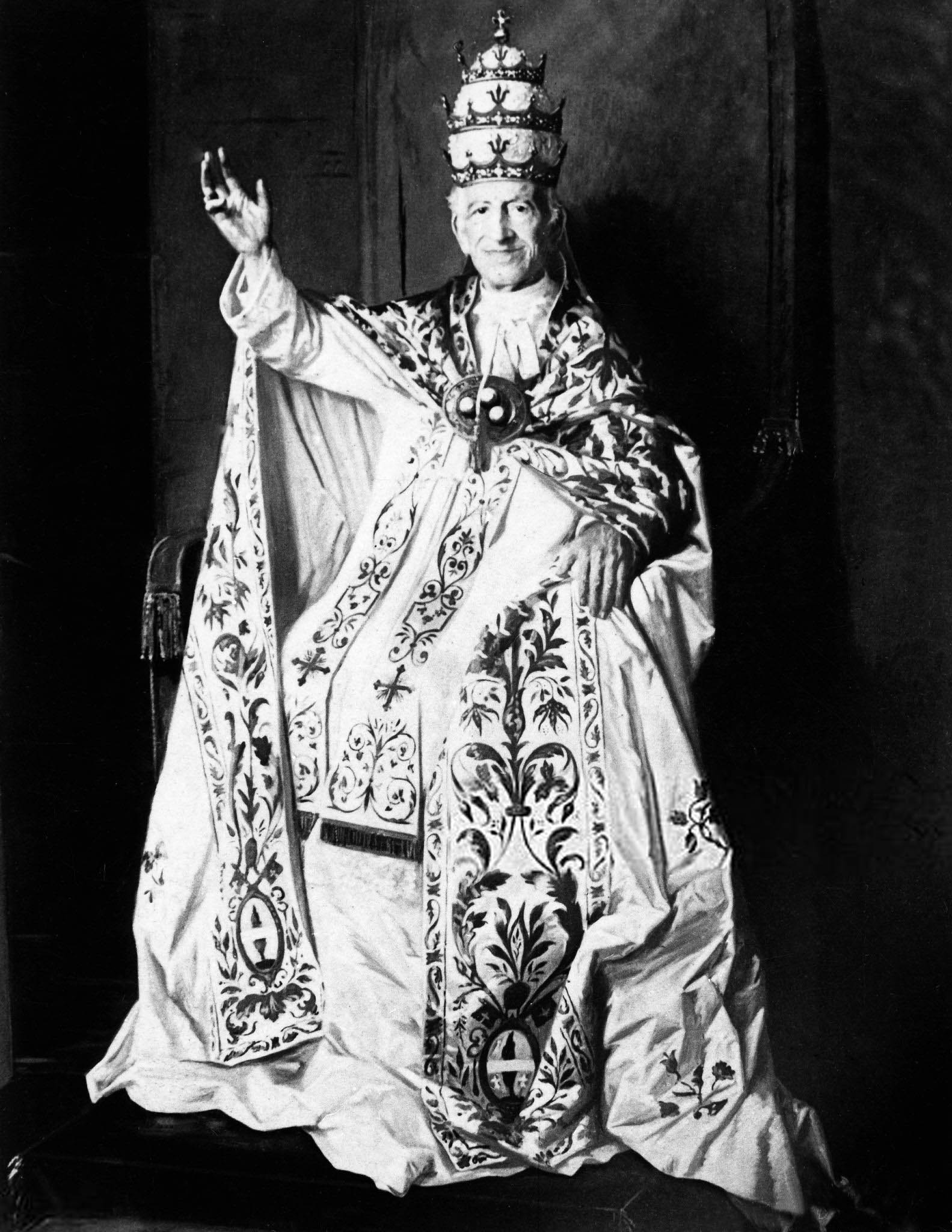
Pope Leo: "St. Thomas Inherited the Intellect of All the Ancient Doctors"


Share/Bookmark
On the 132nd Anniversary of Pope Leo's Encyclical on Christian Philosophy.
Taken from Aeterni Patris, no. 17.

Among the Scholastic Doctors, the chief and master of all towers Thomas Aquinas, who, as Cajetan observes, because "he most venerated the ancient doctors of the Church, in a certain way seems to have inherited the intellect of all." (34) The doctrines of those illustrious men, like the scattered members of a body, Thomas collected together and cemented, distributed in wonderful order, and so increased with important additions that he is rightly and deservedly esteemed the special bulwark and glory of the Catholic faith. With his spirit at once humble and swift, his memory ready and tenacious, his life spotless throughout, a lover of truth for its own sake, richly endowed with human and divine science, like the sun he heated the world with the warmth of his virtues and filled it with the splendor of his teaching. Philosophy has no part which he did not touch finely at once and thoroughly; on the laws of reasoning, on God and incorporeal substances, on man and other sensible things, on human actions and their principles, he reasoned in such a manner that in him there is wanting neither a full array of questions, nor an apt disposal of the various parts, nor the best method of proceeding, nor soundness of principles or strength of argument, nor clearness and elegance of style, nor a facility for explaining what is abstruse.


Tuesday, August 02, 2011

St. Alphonsus's Theologia Moralis: The Magisterially-Guaranteed Manual of Casuistry


Share/Bookmark Quoted from Gousset, La justification de la théologie morale du bienheureux Alphonse-Marie de Liguori, p. 197:


English Translation 
(Copyright © 2011 Francisco J. Romero Carrasquillo and Ite ad Thomam.  All rights reserved.)

1) Whether the professor of Sacred Theology can safely follow and profess the opinions that St. Alphonsus Liguori professes in his Theologia Moralis?

2) Whether a confessor is to be reprimanded who, in the practice of the sacred Tribunal of [the Sacrament of] Penance, follows all of the opinions of St. Alphonsus Liguori, merely because the Holy Apostolic See has not found anything in his works worthy of censure?  The confessor of whom we inquire does not read the works of the Holy Doctor except to know accurately his doctrine; not to examine their importance or their reasons, concerning which there are many opinions; but considers himself to act safely by the very fact that he prudently judges the doctrine which does not contain anything worthy of censure to be sound, safe, and not contrary in any way to the holiness of the Gospel.

Decision

The Holy Penitentiary having weighed the above [...] resolved to respond:

1) To the first question: Affirmatively, so long as he does not thereby deem as reprehensible those who follow the opinions proposed by other approved Authors.

2) To the second question: Negatively, given the mind of the Holy See concerning the approbation of the writings of the servants of God for the purpose of Canonization. 

Given in Rome, in the Sacred Penitentiary, the fifth day of July, 1831.

A.F. de Retz, S.P. Regens
F. Fricca, S.P. Secretarius

Concordat cum Originali.

A. Cardinalis, Archiepiscopus Vesontionensis.

------------

St. Alphonsus' Theologia Moralis is available in 4 volumes from ITOPL

Meet the Doctors: St. Alphonsus Liguori


Share/Bookmark

From Matins of the Feast of St. Alphonsus Liguouri, Bishop, Confessor, Doctor (2nd Nocturn)
Online Source: www.breviary.net

Lesson iv
Alfónsus María de Ligório, Neápoli nobílibus paréntibus natus, ab ineúnte ætáte non obscúra præbuit sanctitátis indícia.  Eum adhuc infántem cum paréntes obtulíssent sancto Francísco de Hierónymo e societáte Jesu, is bene precátus edíxit eúmdem ad nonagésimum usque annum perventúrum, ad episcopálem dignitátem evéctum iri, maximóque Ecclésiæ bono futúrum.  Jam tum a puerítia, a ludis abhórrens, nóbiles ephébos ad christiánam modéstiam verbo et exémplo componébat.  Adoléscens, dato piis sodalitátibus nómine, in públicis nosocomíis ægrótis inservíre, jugi in templis oratióni vacáre, ac sacra mystéria frequénter obíre in delíciis habébat.  Pietátem litterárum stúdiis ádeo conjúnxit, ut séxdecim vix annos natus utriúsque juris láuream in pátria universitáte fúerit assecútus.  Patri obtémperans, causárum patrocínia suscépit ; in quo múnere obeúndo, etsi magnam sibi laudem comparásset, fori tamen perícula expértus, ejúsmodi vitæ institútum ultro dimísit.  Spreto ígitur præcláro conjúgio sibi a patre propósito, avíta primogenitúra abdicáta, et ad aram Vírginis de Mercéde ense suspénso, divínis ministériis se mancipávit.  Sacérdos factus, tanto zelo írruit in vítia, ut apostólico múnere fungens, huc illuc pérvolans, ingéntes perditórum hóminum conversiónes perágeret.  Páuperum præsértim et ruricolárum miserátus, congregatiónem Presbyterórum instítuit sanctíssimi Redemptóris, qui, ipsum Redemptórem secúti, per agros, pagos, et castélla paupéribus evangelizárent.
Alphonsus Mary Liguori was born of a noble family at Naples.  From his earliest days he gave no dark signs of holiness.  When he was but a babe, his parents carried him to holy Francis de Geronimo, of the Society of Jesus, and holy Francis, after long prayer, said that the child would live to ninety years of age, that he would become a Bishop, and that he would be a great blessing to the Church.  From his childhood, he had a strong distaste to games, and by his entreaty and example, induced the noble pages to conduct themselves with Christian decency.  As a young man, he became a member of divers godly guilds, and made it among his delights to nurse the sick in the hospitals, to spend much time in prayer in the Churches, and often to receive the Holy Sacraments.  With his godliness he so joined zeal for learning, that when he was scarcely sixteen years of age he took degrees in Canon and Civil Law in the University of Naples.  In obedience to the wish of his father, he adopted the profession of an advocate, in which he gained great credit, but, finding dangers in the practice of the law, he entirely gave it up.  He declined a very brilliant marriage which was proposed to him by his father, resigned his family inheritance as an eldest son, hung up his sword at the Altar of the Blessed Virgin Mary, styled of Ransom, and surrendered himself altogether to the service of God.  He became a Priest, and made so zealous an onslaught on sin, running hither and thither in the office of an Apostle, that he accomplished the conversion of multitudes of lost creatures.  The poor and the country-people most chiefly roused his compassion, and he founded the Congregation of Priests called that of the Most Holy Redeemer, to follow the Redeemer's footsteps by preaching the Gospel to the poor throughout the fields, villages, and hamlets.
V.  Tu autem, Dómine, miserére nobis.
R.  Deo grátias.
V.  But thou, O Lord, have mercy upon us.
R.  Thanks be to God.

University of Naples
R.  Invéni David servum meum, óleo sancto meo unxi eum : * Manus enim mea auxiliábitur ei.
V.  Nihil profíciet inimícus in eo, et fílius iniquitátis non nocébit ei.
R.  Manus enim mea auxiliábitur ei.
R.  I have found David my servant, with my holy oil have I anointed him. * My hand shall hold him fast.
V.  The enemy shall not be able to do him violence ; the son of wickedness shall not hurt him.
R.  My hand shall hold him fast.

V.  Jube domne, (Dómine) benedícere.
V.  Vouchsafe, Reverend Father (O Lord), thy blessing.
Benedíctio 5: Christus perpétuæ det nobis gáudia vitæ.R.  Amen.
Benediction 5: May Christ bestow upon us the joys of life eternal.
R.  Amen.
Lesson v

Icon of Our Lady of Perpetual Help
in the Redemptorist Church of St. Alphonsus in Rome
Ne autem a propósito umquam divérteret, perpétuo se voto obstrínxit nullam témporis jactúram faciéndi.  Hinc animárum zelo succénsus, tum divíni verbi prædicatióne, tum scriptis sacra eruditióne et pietáte refértis, ánimas Christo lucrifácere et ad perfectiórem vitam addúcere stúduit.  Mirum sane quot ódia exstínxerit, quot dévios ad rectum salútis iter revocáverit.  Dei Genitrícis cultor exímius, de illíus láudibus librum édidit, ac de iis dum fervéntius concionándo dísserit, a Vírginis imágine, in eum immísso miro splendóre, totus fácie coruscáre et in éxtasim rapi coram univérso pópulo non semel visus est.  Dominicæ passiónis et sacræ Eucharístiæ contemplátor assíduus, ejus cultum mirífice propagávit.  Dum vero ad ejus aram oráret vel Sacrum fáceret, quod numquam omísit, præ amóris veheméntia, vel seráphicis liquescébat ardóribus, vel insólitis quatiebátur mótibus, vel abstrahebátur a sénsibus.  Miram vitæ innocéntiam, quam nulla umquam letháli labe fœdávit, pari cum pœniténtia sócians, corpus suum inédia, férreis caténulis, cilíciis cruentáque flagellatióne castigábat.  Inter hæc prophetíæ, scrutatiónis córdium, bilocatiónis et miraculórum donis incláruit.
That he might not turn aside from his work, he bound himself by a vow never to lose any time.  Inflamed with the love of souls, he toiled to gain them to Christ and to amend their lives, not only by preaching of the word of God, but also by writings full of holy learning and godliness.  It is a marvel how many hatreds he stilled, and how many backsliders he led again into the paths of salvation.  He was eminently devoted to the Mother of God, published a book on her glories, and when he was earnestly speaking thereof in his sermons, it happened more than once that all the people openly saw a strange brightness fall upon him from her image, till all his countenance shone, and he was rapt in an ecstasy.  The sufferings of the Lord and the Holy Eucharist were ever before his eyes, and to them he spread abroad a wonderful love.  When he was praying before the Altar of the Blessed Sacrament, or celebrating the Holy Liturgy, which he never failed to do every day, through the seraphic violence of his love, he wept burning tears, or shook with strange movements, or became altogether beside himself.  He joined a wonderful innocence and purity, which he never polluted by the stain of deadly sin, to a wonderful depth of repentance, and chastised his body with hunger, iron chains, hair-cloth, and scourgings even to blood-shedding.  Among all these things he was remarkable for the gift of prophecy, the power of seeing into the hearts of men, the ability to be in more places than one at the same time, and other miracles.
V.  Tu autem, Dómine, miserére nobis.
R.  Deo grátias.
V.  But thou, O Lord, have mercy upon us.
R.  Thanks be to God.

Church of St. Alphonsus, Rome
R.  Pósui adjutórium super poténtem, et exaltávi eléctum de plebe mea : * Manus enim mea auxiliábitur ei.
V.  Invéni David servum meum, óleo sancto meo unxi eum.
R.  Manus enim mea auxiliábitur ei.
R.  I have laid help upon one that is mighty, I have exalted one chosen out of the people. * My hand shall hold him fast.V.  I have found David, my servant, with my holy oil have I anointed him.
R.  My hand shall hold him fast.

V.  Jube domne, (Dómine) benedícere.
V.  Vouchsafe, Reverend Father (O Lord), thy blessing.
Benedíctio 6: Ignem sui amóris accéndat Deus in córdibus nostris.
R.  Amen.
Benediction 6: May God enkindle in our hearts the fire of his holy love.
R.  Amen.
Lesson vi
Ab ecclesiásticis dignitátibus sibi oblátis constantíssime abhórruit ; at, Cleméntis décimi tértii Pontíficis auctoritáte coáctus, sanctæ Agathæ Gothórum ecclésiam gubernándum suscépit.  Epíscopus, extérnum dumtáxat hábitum, non autem sevéram vivéndi ratiónem immutávit.  Eadem frugálitas, summus christiánæ disciplínæ zelus, impénsum in vítiis coërcéndis arcendísque erróribus, et in réliquis pastorálibus munéribus obeúndis stúdium.  Liberális in páuperes, omnes ecclésiæ provéntus iísdem distribuébat, ac, urgénte annónæ caritáte, ipsam domésticam supelléctilem in aléndis famélicis erogávit.  Omnibus ómnia factus, sanctimoniáles ad perfectiórem vivéndi formam redégit, suæque congregatiónis moniálium monastérium constituéndum curávit.  Episcopátu ob graves habitualésque morbos dimísso, ad alúmnos suos, a quibus pauper discésserat, revértitur pauper.  Demum, quamvis senio laboribúsque, diutúrna arthrítide aliísque gravíssimis morbis fractus córpore, spíritu tamen alácrior, de cæléstibus rebus disseréndi aut scribéndi finem numquam adhíbuit, donec nonagenárius, Kaléndis Augústi, anno millésimo septingentésimo octogésimo séptimo, Nucériæ Paganórum, inter suórum alumnórum lácrimas, placidíssime exspirávit.  Eum, inde virtútibus et miráculis clarum, Pius séptimus Póntifex máximus anno millésimo octingentésimo décimo sexto Beatórum fastis ; novísque fulgéntem signis, Gregórius décimus sextus in festo sanctíssimæ Trinitátis, anno millésimo octingentésimo trigésimo nono, solémni ritu, Sanctórum catálogo accénsuit.  Tandem Pius nonus Póntifex máximus, ex sacrórum Rítuum Congregatiónis consúlto, universális Ecclésiæ Doctórem declarávit.
He firmly and perseveringly refused all high places in the Church which were offered him, but Pope Clement XIII absolutely commanded him to take the Bishoprick of the Church of Santa Agata dei Goti.  On becoming a Bishop, the only change which he made in the hardness of his life was that of his outer raiment.  There remained, too, the same simplicity of meats, the same strong zeal for Christian discipline, the same determined will to put down sin and keep out false doctrines, and the same earnestness in all the duties of a shepherd of souls.  In his tenderness to the poor, he spent among them all the revenues of his Church, and in a year of famine sold the furniture of his own house to feed his starving people.  He was all things to all men ; and brought nuns to lead a more perfect life, while he saw to it that a monastery was opened for nuns attached to his own Congregation.  On account of grievous and continual sickness, he resigned his Bishoprick, and poor as when he had left them, poor he returned among his disciples.  On the 1st day of August, in the year 1787, he peacefully died at Nocera-dei-Pagani, amid the tears of his followers.  He was then ninety years of age ; his body was worn out with old age and hard work, and with chronic gout, and other painful maladies, but the freshness of his mind never failed to the last, in talking and writing on heavenly things.  In the year 1816 Pope Pius VII, finding him famous on account of his good works and miracles, enrolled his name among those of the Blessed.  God still glorified him by new signs and wonders, and on the Feast of the Most Holy Trinity, in the year 1839, Gregory XVI, with solemn pomp, numbered him among the Saints of the Church.  Lastly, Pope Pius IX, in accordance with a resolution of the Congregation of Sacred Rites, gave him the title of Doctor of the Universal Church.
V.  Tu autem, Dómine, miserére nobis.
R.  Deo grátias.
V.  But thou, O Lord, have mercy upon us.
R.  Thanks be to God.
R.  Iste est, qui ante Deum magnas virtútes operátus est, et omnis terra doctrína ejus repléta est : * Ipse intercédat pro peccátis ómnium populórum.V.  Iste est, qui contémpsit vitam mundi, et pervénit ad cæléstia regna.
R.  Ipse intercédat pro peccátis ómnium populórum.V.  Glória Patri, et Fílio, et Spirítui Sancto.
R.  Ipse intercédat pro peccátis ómnium populórum.
R.  This is he who wrought mighty deeds and valiant in the sight of God, and all the earth is filled with his doctrine: May his intercession avail for the sins of all the people.V.  He was a man who despised the life of the world and attained unto the kingdom of heaven.
R.  May his intercession avail for the sins of all the people.V.  Glory be to the Father, and to the Son, and to the Holy Ghost.
R.  May his intercession avail for the sins of all the people.


Friday, July 29, 2011

St. Thomas on Ecumenism


Share/Bookmark The following is what can be found in St. Thomas' works on ecumenism:


The 'Moderate' Cardinal Bea on Inerrancy in Dei Verbum 11


Share/Bookmark
From Augustin Cardinal Bea, The Word of God and Mankind (Chicago: Franciscan Herald Press, 1967), pp. 188-190.

An earlier schema (the third in succession) said that the sacred books teach 'truth without error'. The following schema, the fourth, inspired by words of St. Augustine, added the adjective 'saving', so that the text asserted that the Scriptures taught 'firmly, faithfully, wholly and without error the saving truth.' In the voting which followed one hundred and eighty-four council fathers asked for the adjective 'saving' to be removed, because they feared it might lead to misunderstandings, as if the inerrancy of Scripture referred only to matters of faith and morality, whereas there might be error in the treatment of other matters. The Holy Father, to a certain extent sharing this anxiety, decided to ask the Commission to consider whether it would not be better to omit the adjective, as it might lead to some misunderstanding. 

Does the inerrancy asserted in this document cover also the account of these historical events? [...]  For my own part I think that this question must be answered affirmatively, that is, that these 'background' events also are described without error. In fact, we declare in general that there is no limit set to this inerrancy, and that it applies to all that the inspired writer, and therefore all that the Holy Spirit by his means, affirms.... This thought, which re-occurs in various forms in the recent documents of the Magisterium of the Church (cf. E.B. 124, 279, 450 et seq., 539 et seq., 559) is here clearly understood in a sense which excludes the possibility of the Scriptures containing any statement contrary to the reality of the facts. In particular, these documents of the Magisterium require us to recognize that Scripture gives a true account of events, naturally not in the sense that it always offers a complete and scientifically studied account, but in the sense that what is asserted in Scripture - even if it does not offer a complete picture - never contradicts the reality of the fact. If therefore the Council had wished to introduce here a new conception, different from that presented in these recent documents of the supreme teaching authority, which reflects the beliefs of the early fathers, it would have had to state this clearly and explicitly. Let us now ask whether there may be any indications to suggest such a restricted interpretation of inerrancy. The answer is decidedly negative. There is not the slightest sign of any such indication. On the contrary everything points against a restrictive interpretation.


Wednesday, July 27, 2011

Council of Basle on the Vacant Apostolic See During a Council


Share/Bookmark
580th Anniversary the Opening of the Council of Basle, July 25, 1431 (17th Ecumenical Council)

[If the apostolic see becomes vacant while the council is in progress, the election may not be held outside the council]'

The holy general synod of Basel, legitimately assembled in the holy Spirit, representing the universal church, bears in mind that it pertains to the duty of providence to foresee the future with clear-sighted consideration and to take wholesome steps against what could bring harm to the common good. The synod is intent upon the extirpation of heresies, peace among the people of Christ and the reformation of morals, with the grace of the holy Spirit, as is really necessary in view of the present situation. It has summoned the venerable fathers in Christ, the cardinals of the holy Roman church, to this sacred council, convinced that their presence at it is fruitful in many ways in view of their authority, wisdom and knowledge of affairs. If, then, as obedient sons they are coming to the council when the apostolic see falls vacant elsewhere, such a situation would redound to the benefit of the church but the obedient cardinals would be serving the council to their own disadvantage, whereas everyone knows that obedience should bring with it not disadvantage but an increase of benefit and honour. Lest disobedience may seem to be to the advantage of some who fail to come, this holy synod, with purposeful anticipation and for the above and other reasons which can and should motivate a prudent mind establishes, decrees and defines that, in the event of a vacancy of the apostolic see while this sacred council is in progress, the election of the supreme pontiff shall be held in the place of this sacred council, and it forbids it to be held elsewhere. The synod also decrees that any attempt against this by any authority whatsoever, be it even papal, notwithstanding any constitutions issued or to be issued or anything else acting to the contrary, even if there should be special mention in so many words or a confirmation on oath, which the synod rejects with full knowledge, is null and void and of no force or importance by law; and that those who attempt such things shall be disqualified in both active and passive voice with respect to the election of a Roman pontiff and for every other dignity, and deprived perpetually of all dignities which they hold, and shall automatically incur the mark of infamy as well as sentence of excommunication. If any such pretended election should be attempted, then both the one allegedly elected and his supporters as well as those who treat him as elected incur in the same way the above-mentioned penalties. The said synod reserves to itself, except at the moment of death, absolution of everyone who in any way shall incur the said sentences or any one of them. It declares that the present decree shall bind and come into force after forty days following its publication.

Thursday, July 21, 2011

Meet the Doctors: St. Laurence of Brindisi


Share/Bookmark
On the Feast of St. Laurence of Brindisi, OFM, Cap., Confessor and Doctor (July 21)
From Catholic Encyclopedia, "St. Lorenzo da Brindisi"

(Also: Lawrence, or Laurence, of Brindisi.)

Born at Brindisi in 1559; died at Lisbon on 22 July, 1619. In baptism he received the names of Julius Caesar. Guglielmo de Rossi — or Guglielmo Russi, according to a contemporary writer — was his father's name; his mother was Elisabetta Masella. Both were excellent Christians. Of a precocious piety, Lorenzo gave early evidence of a religious vocation. The Conventuals of Brindisi were entrusted with his education. His progress in his studies was very rapid, and, when barely six, he had already given indication of his future success in oratory. Consequently, he was always the one chosen to address, in accordance with the Italian custom, a short sermon to his compatriots on the Infant Jesus during the Christmas festivities. When he was twelve years of age his father died. He then pursued his studies at Venice with the clerics of St. Mark's and under the supervision of one of his uncles. In 1575 he was received into the Order of Capuchins under the name of Brother Lorenzo, and, after his profession, made his philosophical and theological studies at the University of Padua. Owing to his wonderful memory he mastered not only the principal European languages, but also most of the Semitic tongues. It was said he knew the entire original text of the Bible. Such a knowledge, in the eyes of many, could be accounted for only by supernatural assistance, and, during the process of beatification, the examiners of the saint's writings rendered the following judgment: "Vere inter sanctos Ecclesiae doctores adnumerari potest."

Such unusual talents, added to a rare virtue, fitted Brother Lorenzo for the most diverse missions. When still a deacon he preached the Lenten sermons in Venice, and his success was so great that he was called successively to all the principal cities of the peninsula. Subsequently, thanks to his numerous journeys, he was enabled to evangelize at different periods most of the countries of Europe. The sermons he left fill no less than eight folio volumes. He adopted the method of preaching in favour with the great Franciscan missionaries, or rather with apostolic workers of all times, who, aiming primarily to reach men's hearts and convert them, always adapt their style of discourse to the spiritual needs of their hearers. Brother Lorenzo held successively all the offices of his order. From 1596 to 1602 he had, as general definitor, to fix his residence in Rome. Clement VIII assigned him the task of instructing the Jews; thanks to his knowledge of Hebrew and his powerful reasoning, he brought a great number of them to recognize the truth of the Christian religion. His saintliness, combined with his great kindliness, completed the preparing of the way for the grace of conversion. His success in Rome caused him to be called to several other cities, where he also baptized numerous Jews. At the same time he was commissioned to establish houses of his order in Germany and Austria. Amid the great difficulties created by the heretics he founded the convents of Vienna, Prague, and Graz, the nuclei of three provinces. At the chapter of 1602 he was elected vicar-general. (At that time the Order of Capuchins, which had broken away from the Observants in 1528 and had an independent constitution, gave its first superior the title of vicar-general only. It was not until 1618 that Pope Paul V changed it to that of minister general). The very year of his election the new superior began the visitation of the provinces. Milan, Paris, Marseilles, Spain, received him in turn. As his coming was preceded by a great reputation for holiness, the people flocked to hear him preach and to receive his blessing. His administration characterized by wise firmness and fatherly tenderness, was of great benefit to the order. At the Chapter of 1605 he refused to undertake for a second term the government of his brethren, but until his death he was the best adviser of his successors.

It was on the occasion of the foundation of the convent of Prague (1601) that St. Lorenzo was named chaplain of the Imperial army, then about to march against the Turks. The victory of Lepanto (1571) had only temporarily checked the Moslem invasion, and several battles were still necessary to secure the final triumph of the Christian armies. Mohammed III had, since his accession (1595), conquered a large part of Hungary. The emperor, determined to prevent a further advance, sent Lorenzo of Brindisi as deputy to the German princes to obtain their cooperation. They responded to his appeal, and moreover the Duke of Mercœur, Governor of Brittany, joined the imperial army, of which he received the effective command. The attack on Albe-Royal (now Stulweissenburg) was then contemplated. To pit 18,000 men against 80,000 Turks was a daring undertaking and the generals, hesitating to attempt it, appealed to Lorenzo for advice. Holding himself responsible for victory, he communicated to the entire army in a glowing speech the ardour and confidence with which he was himself animated. As his feebleness prevented him from marching, he mounted on horseback and, crucifix in hand, took the lead of the army, which he drew irresistibly after him. Three other Capuchins were also in the ranks of the army. Although the most exposed to danger, Lorenzo was not wounded, which was universally regarded as due to a miraculous protection. The city was finally taken, and the Turks lost 30,000 men. As however they still exceeded in numbers the Christian army, they formed their lines anew, and a few days later another battle was fought. It always the chaplain who was at the head of the army. "Forward!" he cried, showing them the crucifix, "Victory is ours." The Turks were again defeated, and the honour of this double victory was attributed by the general and the entire army to Lorenzo.

Having resigned his office of vicar-general in 1605, he was sent by the pope to evangelize Germany. He here confirmed the faith of the Catholics, brought back a great number to the practice of virtue, and converted many heretics. In controversies his vast learning always gave him the advantage, and, once he had won the minds of his hearers, his saintliness and numerous miracles completed their conversion. To protect the Faith more efficaciously in their states, the Catholic princes of Germany formed the alliance called the "Catholic League". Emperor Rudolph sent Lorenzo to Philip III of Spain to persuade him to join the League. Having discharged this mission successfully, the saintly ambassador received a double mandate by virtue of which he was to represent the interests of the pope and of Madrid at the court of Maximilian of Bavaria, head of the League. He was thus, much against his wishes, compelled to settle in Munich near Maximilian. Besides being nuncio and ambassador, Lorenzo was also commissary general of his order for the provinces of Tyrol and Bavaria, and spiritual director of the Bavarian army. He was also chosen as arbitrator in the dispute which arose between the princes, and it was in fulfillment of this role that, at the request of the emperor, he restored harmony between the Duke of Mantua and a German nobleman. In addition to all these occupations he undertook, with the assistance of several Capuchins, a missionary campaign throughout Germany, and for eight months travelled in Bavaria, Saxony, and the Palatinate.

Amid so many various undertakings Lorenzo found time for the practices of personal sanctification. And it is perhaps the greatest marvel of his life to have combined with duties so manifold an unusually intense inner life. In the practice of the religious virtues St. Lorenzo equals the greatest saints. He had to a high degree the gift of contemplation, and very rarely celebrated Holy Mass without falling into ecstasies. After the Holy Sacrifice, his great devotion was the Rosary and the Office of the Blessed Virgin. As in the case of St. Francis of Assisi, there was something poetical about his piety, which often burst forth into canticles to the Blessed Virgin. It was in Mary's name that he worked his miracles, and his favourite blessing was: "Nos cum prole pia benedicat Virgo Maria." Having withdrawn to the monastery of Caserta in 1618, Lorenzo was hoping to enjoy a few days of seclusion, when he was requested by the leading men of Naples to go to Spain and apprise Philip III of the conduct of Viceroy Ossuna. In spite of many obstacles raised by the latter, the saint sailed from Genoa and carried out his mission successfully. But the fatigues of the journey exhausted his feeble strength. He was unable to travel homeward, and after a few days of great suffering died at Lisbon in the native land of St. Anthony (22 July, 1619), as he had predicted when he set out on his journey. He was buried in the cemetery of the Poor Clares of Villafranca.

The process of beatification, several times interrupted by various circumstances, was concluded in 1783. The canonization took place on 8 December, 1881. With St. Anthony, St. Bonaventure, and Blessed John Duns Scotus, he is a Doctor of the Franciscan Order.

The known writings of St. Lorenzo of Brindisi comprise eight volumes of sermons, two didactic treatises on oratory, a commentary on Genesis, another on Ezechiel, and three volumes of religious polemics. Most of his sermons are written in Italian, the other works being in Latin. The three volumes of controversies have notes in Greek and Hebrew.