Showing posts with label Predestination. Show all posts

Wednesday, July 18, 2012

Quaeritur: Premotion in Aquinas and His Commentators


Share/Bookmark

Quaeritur: I am interested in the topic of pre-motion within the thought of St. Thomas and his commentators, specifically Garrigou-Lagrange.  I was wondering if you could point me in the right direction for some information on this within the corpus of Thomas himself and in his commentators.  A friend of mine was giving me some brief explanations of this topic and I was interested, but have not been able to make a lot of progress.

Respondeo: Below are a couple of texts in Aquinas that clearly teach premotion (without calling it such---the term is Báñez's).  But, in addition, I wholeheartedly recommend Garrigou's own Predestination, which is really the best work out there on the topic.  After that, I would recommend tackling Báñez's commentary on the Prima Pars.  Both are available from ITOPL.  Báñez's commentary, of course, remains untranslated, but Garrigou's book is available in English translation.


Quaestiones disputatae de malo 6.1 ad 3 (my translation):

God immutably moves our will on account of the efficacy of His moving power, which cannot fail; but on account of the nature of the will that is moved, which relates indifferently to diverse things, necessity is not introduced; just as in all things divine providence operates infallibly; and yet from contingent causes effects are contingently produced, insofar as God moves all things proportionately, each being according to its mode.

Deus movet quidem voluntatem immutabiliter propter efficaciam virtutis moventis, quae deficere non potest; sed propter naturam voluntatis motae, quae indifferenter se habet ad diversa, non inducitur necessitas, sed manet libertas; sicut etiam in omnibus providentia divina infallibiliter operatur; et tamen a causis contingentibus proveniunt effectus contingenter, in quantum Deus omnia movet proportionabiliter, unumquodque secundum suum modum.


ST I.83.1: Whether man has free-will? (My translation, emphasis added).

[Argument 3]. Further, that is free which is cause of itself, as is said in the first book of the Metaphysics [ch. 2]. What is moved by another, therefore, is not free. But God moves the will, for it is said in Proverbs 21[:1], "The heart of the king is in the hand of the Lord; whithersoever He will He shall turn it," and in Philippians 2[:13], "It is God Who worketh in you both to will and to accomplish."

To the 3rd, it must be said that the free will is a cause of its motion, because man through his free will moves himself to acting. But it does not necessarily belong to freedom that it be its own first cause. God, therefore, is the first cause that moves both natural and voluntary causes. And just as, by moving natural causes, he does not take away the fact that their acts are natural; so by moving voluntary causes, he does not take away the fact that their actions are voluntary, but rather makes this very thing [i.e., being voluntary] in them, for he operates in each thing according to what is proper to it.

Praeterea, liberum est quod sui causa est, ut dicitur in I Metaphys. Quod ergo movetur ab alio, non est liberum. Sed Deus movet voluntatem, dicitur enim Prov. XXI, cor regis in manu Dei, et quocumque voluerit vertet illud; et Philipp. II, Deus est qui operatur in nobis velle et perficere. Ergo homo non est liberi arbitrii.Ad tertium dicendum quod liberum arbitrium est causa sui motus, quia homo per liberum arbitrium seipsum movet ad agendum. Non tamen hoc est de necessitate libertatis, quod sit prima causa sui id quod liberum est, sicut nec ad hoc quod aliquid sit causa alterius, requiritur quod sit prima causa eius. Deus igitur est prima causa movens et naturales causas et voluntarias. Et sicut naturalibus causis, movendo eas, non aufert quin actus earum sint naturales; ita movendo causas voluntarias, non aufert quin actiones earum sint voluntariae, sed potius hoc in eis facit, operatur enim in unoquoque secundum eius proprietatem.


Friday, March 04, 2011

God is the Prime Mover of All Things, Even the Will's Free Acts


Share/Bookmark

Quaestiones disputatae de malo 6.1 ad 3 (my translation):

God immutably moves our will on account of the efficacy of His moving power, which cannot fail; but on account of the nature of the will that is moved, which relates indifferently to diverse things, necessity is not introduced; just as in all things divine providence operates infallibly; and yet from contingent causes effects are contingently produced, insofar as God moves all things proportionately, each being according to its mode.

Deus movet quidem voluntatem immutabiliter propter efficaciam virtutis moventis, quae deficere non potest; sed propter naturam voluntatis motae, quae indifferenter se habet ad diversa, non inducitur necessitas, sed manet libertas; sicut etiam in omnibus providentia divina infallibiliter operatur; et tamen a causis contingentibus proveniunt effectus contingenter, in quantum Deus omnia movet proportionabiliter, unumquodque secundum suum modum.


ST I.83.1: Whether man has free-will? (My translation, emphasis added).

[Argument 3]. Further, that is free which is cause of itself, as is said in the first book of the Metaphysics [ch. 2].  What is moved by another, therefore, is not free.  But God moves the will, for it is said in Proverbs 21[:1], "The heart of the king is in the hand of the Lord; whithersoever He will He shall turn it," and in Philippians 2[:13], "It is God Who worketh in you both to will and to accomplish."

To the 3rd, it must be said that the free will is a cause of its motion, because man through his free will moves himself to acting.  But it does not necessarily belong to freedom that it be its own first cause.  God, therefore, is the first cause that moves both natural and voluntary causes.  And just as, by moving natural causes, he does not take away the fact that their acts are natural; so by moving voluntary causes, he does not take away the fact that their actions are voluntary, but rather makes this very thing [i.e., being voluntary] in them, for he operates in each thing according to what is proper to it.


Praeterea, liberum est quod sui causa est, ut dicitur in I Metaphys. Quod ergo movetur ab alio, non est liberum. Sed Deus movet voluntatem, dicitur enim Prov. XXI, cor regis in manu Dei, et quocumque voluerit vertet illud; et Philipp. II, Deus est qui operatur in nobis velle et perficere. Ergo homo non est liberi arbitrii.


Ad tertium dicendum quod liberum arbitrium est causa sui motus, quia homo per liberum arbitrium seipsum movet ad agendum. Non tamen hoc est de necessitate libertatis, quod sit prima causa sui id quod liberum est, sicut nec ad hoc quod aliquid sit causa alterius, requiritur quod sit prima causa eius. Deus igitur est prima causa movens et naturales causas et voluntarias. Et sicut naturalibus causis, movendo eas, non aufert quin actus earum sint naturales; ita movendo causas voluntarias, non aufert quin actiones earum sint voluntariae, sed potius hoc in eis facit, operatur enim in unoquoque secundum eius proprietatem.


ST I.83.1 arg 3, ad 3, in Syllogistic Format (in my own words):

Argument 3:

Major: What is moved by another is not free.
Minor: The will is moved by another.
Conclusion: Therefore, the will is not free.

Proof of the Major: "What is free is moved by itself" (Metaph. I.2).  Therefore, what is moved by another is not free. Proof of the Minor: God moves the will (cf. Prov. 21:1; Phil. 2:13).  And the conclusion follows.


St. Thomas' Reply:

I concede the minor.

I distinguish the major.  That what is moved by another as by its only cause is not free, I concede; but that what is moved by another as by its first cause is not free, I deny.  God is the primary cause of the will's actions, and the will is the secondary cause of its actions.  God's primary causality does not take away their being free, but rather is the cause of all of their being, including their being free--just as his primary causality of natural actions does not take away their being nature, but rather is the cause of their being, including their being natural.  For God causes all things to be in their own way, natural things to be natural, and voluntary things to be voluntary.

And I deny the conclusion.


Thursday, May 06, 2010

St. Therese on the Mystery of Predestination


Share/Bookmark
From St. Therese of Lisieux, Story of a Soul, Ch. 1:

I often asked myself why God had preferences, why all souls did not receive an equal measure of grace. I was filled with wonder when I saw extraordinary favours showered on great sinners like St. Paul, St. Augustine, St. Mary Magdalen, and many others, whom He forced, so to speak, to receive His grace. In reading the lives of the Saints I was surprised to see that there were certain privileged souls, whom Our Lord favoured from the cradle to the grave, allowing no obstacle in their path which might keep them from mounting towards Him, permitting no sin to soil the spotless brightness of their baptismal robe. And again it puzzled me why so many poor savages should die without having even heard the name of God.

Our Lord has deigned to explain this mystery to me. He showed me the book of nature, and I understood that every flower created by Him is beautiful, that the brilliance of the rose and the whiteness of the lily do not lessen the perfume of the violet or the sweet simplicity of the daisy. I understood that if all the lowly flowers wished to be roses, nature would lose its springtide beauty, and the fields would no longer be enamelled with lovely hues. And so it is in the world of souls, Our Lord's living garden. He has been pleased to create great Saints who may be compared to the lily and the rose, but He has also created lesser ones, who must be content to be daisies or simple violets flowering at His Feet, and whose mission it is to gladden His Divine Eyes when He deigns to look down on them. And the more gladly they do His Will the greater is their perfection.
I understood this also, that God's Love is made manifest as well in a simple soul which does not resist His grace as in one more highly endowed. In fact, the characteristic of love being self-abasement, if all souls resembled the holy Doctors who have illuminated the Church, it seems that God in coming to them would not stoop low enough. But He has created the little child, who knows nothing and can but utter feeble cries, and the poor savage who has only the natural law to guide him, and it is to their hearts that He deigns to stoop. These are the field flowers whose simplicity charms Him; and by His condescension to them Our Saviour shows His infinite greatness. As the sun shines both on the cedar and on the floweret, so the Divine Sun illumines every soul, great and small, and all correspond to His care—just as in nature the seasons are so disposed that on the appointed day the humblest daisy shall unfold its petals.

Wednesday, May 05, 2010

God Predestined Some Souls and Not Others, Not Due to Their Merits, but Due to His Goodness


Share/Bookmark
From St. Thomas Aquinas, Summa Theologiae I.23.5 ad 3:

Objection 3. Further, "There is no injustice in God" (Romans 9:14). Now it would seem unjust that unequal things be given to equals. But all men are equal as regards both nature and original sin; and inequality in them arises from the merits or demerits of their actions. Therefore God does not prepare unequal things for men by predestinating and reprobating, unless through the foreknowledge of their merits and demerits.

Reply to Objection 3. The reason for the predestination of some, and reprobation of others, must be sought for in the goodness of God. Thus He is said to have made all things through His goodness, so that the divine goodness might be represented in things. Now it is necessary that God's goodness, which in itself is one and undivided, should be manifested in many ways in His creation; because creatures in themselves cannot attain to the simplicity of God. Thus it is that for the completion of the universe there are required different grades of being; some of which hold a high and some a low place in the universe. That this multiformity of grades may be preserved in things, God allows some evils, lest many good things should never happen, as was said above (Question 22, Article 2). Let us then consider the whole of the human race, as we consider the whole universe. God wills to manifest His goodness in men; in respect to those whom He predestines, by means of His mercy, as sparing them; and in respect of others, whom he reprobates, by means of His justice, in punishing them. This is the reason why God elects some and rejects others. To this the Apostle refers, saying (Romans 9:22-23): "What if God, willing to show His wrath [that is, the vengeance of His justice], and to make His power known, endured [that is, permitted] with much patience vessels of wrath, fitted for destruction; that He might show the riches of His glory on the vessels of mercy, which He hath prepared unto glory" and (2 Timothy 2:20): "But in a great house there are not only vessels of gold and silver; but also of wood and of earth; and some, indeed, unto honor, but some unto dishonor." Yet why He chooses some for glory, and reprobates others, has no reason, except the divine will. Whence Augustine says (Tract. xxvi. in Joan.): "Why He draws one, and another He draws not, seek not to judge, if thou dost not wish to err." Thus too, in the things of nature, a reason can be assigned, since primary matter is altogether uniform, why one part of it was fashioned by God from the beginning under the form of fire, another under the form of earth, that there might be a diversity of species in things of nature. Yet why this particular part of matter is under this particular form, and that under another, depends upon the simple will of God; as from the simple will of the artificer it depends that this stone is in part of the wall, and that in another; although the plan requires that some stones should be in this place, and some in that place. Neither on this account can there be said to be injustice in God, if He prepares unequal lots for not unequal things. This would be altogether contrary to the notion of justice, if the effect of predestination were granted as a debt, and not gratuitously. In things which are given gratuitously, a person can give more or less, just as he pleases (provided he deprives nobody of his due), without any infringement of justice. This is what the master of the house said: "Take what is thine, and go thy way. Is it not lawful for me to do what I will?" (Matthew 20:14-15).

Sunday, January 31, 2010

Predestination is not in Itself a Calvinist Heresy


Share/Bookmark
Predestination and Free Will: A Survey of Views

The Bible clearly teaches Predestination (see Romans 8-9) and the men of the Renaissance and of the Early Modern Period were well aware of this. None of them would deny that God predestines certain men to eternal salvation. Where they differ is in their attempts to reconcile the fact of predestination with the idea that man has free will. Some simply denied free will, while others explained free will in a way that it could be compatible with divine predestination. So, in short, the Bible teaches predestination.

The Protestant heretics (such as Luther and Calvin) affirmed that God predestined men to eternal life, but they denied that man has free will (since the fall of Adam and Eve, when the human race contracted original sin), and consequently they also denied that man can merit eternal salvation in any way whatsoever. So the reformers in general have: predestination with no free will and no merit.

Luther taught that God predestines certain men to salvation, and this they cannot merit because it is not in their power to chose (there is no free will since the fall of Adam and Eve); however, God did not predestine any men to eternal damnation, but rather they simply earn their damnation through their lack of faith--this is called positive or single predestination. In short, Luther has: single predestination with no free will and no merit.

Calvin taught that God predestines BOTH certain men to eternal salvation AND others to eternal damnation--this is called double predestination--and neither group earns its destiny because they do not have free will since the fall. In short, Calvin: double predestination with no free will and no merit.

The Catholic Church teaches that there is positive predestination (to salvation) and that man does have free will (i.e., free will was not lost as a consequence of original sin). Predestination, then, means that God chose from all eternity that certain men will USE THEIR FREE WILL to cooperate with His grace and thus merit (in a certain sense) their salvation. But the Church condemns double predestination (which includes predestination to eternal damnation) and teaches that those who are damned are damned because they simply chose to reject God, not because He has predestined them to be damned. In short, the Catholic Church has: single predestination with free will and merit. But this still allows different Catholic theologians to explain how these three facts (single predestination, free will, and merit) fit together:

Thus, Banez affirms everything that the Church teaches (predestination, free will, and merit), but he adds this explanation, taken from St. Thomas Aquinas: God, stands outside of history and is not part of history, is the one who causes all things and, therefore, for a free act to exist, God must cause it. This is the famous "premotion." Thus, all of our acts are BOTH free AND caused by God, and this is not a contradiction. So, in short, Banez has: single predestination with free will, merit, and divine premotion.

Whereas Molina affirms everything that the Church teaches (BOTH predestination AND free will), but he adds this explanation: God is the cause of all things, except man's free will: He only cooperates with free will. But he cooperates with their will because he has a 'scientia media' (i.e., pretty much an 'educated guess') of their future choices: that is, he does not cause human beings to perform salutary acts (acts that will get them to heaven), but only knows who will choose salvation and because of this He cooperates with them to lead them infallibly to salvation. Predestination, then, consists merely in foreknowing the salvation of certain men, and not in infallibly causing their salvation. So, in short, Molina has: single predestination with free will, merit, and mere concurrence.


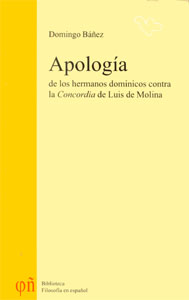
Báñez's commentaries on Aquinas' Summa Theologiae are available through ITOPL.

Thursday, December 31, 2009

Predestination in Sacred Scripture


Share/Bookmark
From Garrigou-Lagrange, OP - Predestination, Ch. 1 (available through ITOPL):

THE SIGNIFICANCE AND REALITY OF PREDESTINATION ACCORDING TO SCRIPTURE
The Gospel is the good tidings of the redemption of the human race which must be preached to all, for our Savior said: "Going therefore, teach ye all nations: baptizing them in the name of the Father and of the Son and of the Holy Ghost. Teaching them to observe all things whatsoever I have commanded you. And behold I am with you all days even to the consummation of the world." St. Paul says in like manner: "God will have all men to be saved and to come to the knowledge of the truth. For there is one God, and one mediator of God and men, the man Christ Jesus, who gave Himself a redemption for all." (2)

God never commands what is impossible and He makes the fulfilment of His precepts really possible for all, both when they are of obligation and according as they are known. However, there are souls that through their own fault are lost; and souls, at times, that have enjoyed a close intimacy with the Savior, as was the case with the "son of perdition." There are others, the elect, who will infallibly be saved. Among these are children who die shortly after being baptized, and adults who, by divine grace, not only can observe the commandments, but actually do so and obtain the gift of final perseverance. Jesus in His sacerdotal prayer said to His Father: "Those whom Thou gavest Me have I kept, and none of them is lost, but the son of perdition, that the Scripture may be fulfilled."(3) Speaking in more general terms, Jesus says again: "My sheep hear My voice. And I know them, and they follow Me. And I give them life everlasting: and they shall not perish for ever. And no man shall pluck them out of My hand. That which My Father hath given Me is greater than all, and no one can snatch them out of the hand of My Father. I and the Father are one."(4) There are elect chosen by God from all eternity. Jesus spoke of them on several occasions. Once He said: "Many are called, but few are chosen." (5) He announced the destruction of Jerusalem, the distress of those times of trial, and He added: "Unless those days had been shortened, no flesh should be saved; but for the sake of the elect those days shall be shortened." (6)

The precise meaning of these utterances of our Savior are made known to us by what St. Paul tells us about predestination, by which God directs and brings the elect infallibly to eternal life. In one of his epistles we read: "What hast thou that thou hast not received? And if thou hast received, why dost thou glory as if thou hadst not received it?"(7) It is but the comment on the words of the Master, who said: "Without Me you can do nothing." (8) St. Paul also says: "For it is God who worketh in you, both to will and to accomplish, according to His good will." When writing to the Ephesians, he speaks explicitly about predestination. "Blessed be the God and Father of our Lord Jesus Christ," he says, "who hath blessed us with spiritual blessings in heavenly places in Christ. As He chose us in Him before the foundation of the world, that we should be holy and unspotted in His sight in charity. Who hath predestinated us unto the adoption of children through Jesus Christ unto Himself, according to the purpose of His will. Unto the praise and glory of His grace, in which He hath graced us in His beloved Son."(10) Again, with more clarity of precision, he writes: "We know that to them that love God all things work together unto good: to such as according to His purpose are called to be saints. For whom He foreknew, He also predestinated to be made conformable to the image of His Son, that He might be the firstborn amongst many brethren. And whom He predestinated, them He also called. And whom He called, them He also justified. And whom He justified, them He also glorified." (11)

With St. Augustine, St. Thomas, and St. Bellarmine, we must remark that in this last text the words, "whom He foreknew, He also predestinated," do not refer to the divine foreknowledge of meritorious acts. Nowhere in St. Paul do we find any foundation for this interpretation, and it would contradict several of his texts, especially this one and the ones we are about to cite. The meaning is: "those whom God foreknew, looking favorably upon them," which is a frequent acceptation of the verb "to know" in the Bible, as in the text: "God has not cast away His people which He foreknew."(12) This exegesis of St. Augustine, St. Thomas, and St. Robert Bellarmine is upheld at the present day by Lagrange, Allo, Zahn, Julicher, and others.(13)

In the Epistle to the Romans (chaps. 9-12), St. Paul in plain terms also sets forth God's sovereign independence in the dispensation of His graces. The Jews, who were the chosen people, are rejected because of their unbelief, and salvation is announced to the Gentiles as a result of Israel's obduracy. The Apostle prophesies, however, the final conversion and salvation of the Jews, and he formulates the principle of predilection, which is applied to nations and individuals: "What shall we say then? Is there injustice with God? God forbid! For He saith to Moses: I will have mercy on whom I will have mercy. And I will show mercy to whom I will show mercy. So then it is not of him that willeth nor of him that runneth, but of God that showeth mercy." (14)

Hence the Apostle's conclusion: "O the depth of the riches of the wisdom and of the knowledge of God! How incomprehensible are His judgments, and how unsearchable His ways! For who hath known the mind of the Lord? Or who hath been His counsellor? Or who hath first given to Him, and recompense shall be made him? For of Him and by Him and in Him are all things. To Him be glory for ever. Amen." (15)

We shall return later on to a discussion of the literal meaning and scope of these texts, when we present the scriptural background for the teaching of St. Thomas. It suffices for the present to point out with the Thomists and St. Robert Bellarmine (16), what Scripture has to say about the gratuitousness of predestination to eternal life. Such is the teaching of Scripture, which declares three indisputable things on this point, namely: (1) God has chosen certain persons to constitute the elect.(17) (2) He has caused this election to be efficacious so that they will infallibly get to heaven: "My sheep shall not perish for ever. And no man shall pluck them out of My hand."(18) "Whom He predestinated, them He also called. And whom He called, them He also justified. And whom He justified, them He also glorified."(19) (3) God's choice of the elect was entirely gratuitous and previous to any consideration of foreseen merits: "Fear not little flock, for it hath pleased your Father to give you a kingdom."(20) "You have not chosen Me, but I have chosen you; and have appointed you, that you should go and should bring forth fruit and your fruit should remain."(21) "Even so then, at this present time also, there is a remnant saved according to the election of grace. And if by grace, it is not now by works, otherwise grace is no more grace."(22) "As He chose us in Him before the foundation of the world, that we should be holy,"(23) and not because we were so, or because He foresaw that we would be so by our own efforts. "For whom He foreknew (in His benevolence), He also predestinated to be made conformable to the image of His Son." (24)

From all these passages of Scripture, St. Augustine formulated this classical definition: "Predestination is the foreknowledge and preparedness on God's part to bestow the favors by which all those are saved who are to be saved."(25) St. Augustine is still more explicit on this point when he writes: "God already knew, when He predestined, what He must do to bring His elect infallibly to eternal life."(26)

-------------

Footnotes
1. Matt. 28: 19-20.
2. I Tim. 2: 3-5.
3. John 17: 12.
4. Ibid., 10: 27-30.
5. Matt. 22: 14.
6. Ibid., 24: 22.
7. I Cor. 4: 7.
8. John 15: 5.
9. Phil. 2: 13
10. Eph. 1: 3-7.
11. Rom. 8: 28--30.
12. Rom. 11: 2; d. Matt. 7: 23; Gal. 4: 9; I Cor. 8: 3; 13: 12; II Tim. 2: 19: Ps. 1: 6.
13. Father Lemonnyer, O.P., has explained the deep significance of this standard text of Rom. 8: 28-30, in his article entitled: "Predestination," which was written for the Dict. de th éol. cath. He remarks that God's intention is manifested in this text by two acts: first, there is the act of foreknowing: "those whom He foreknew" (29); then the act of predestinating: "whom He predestinated" (30). But the act of first intention seems to be passed over in silence. As a matter of fact, remarks Father Lemonnyer, it is indicated in the final clause of v. 29: "that He might be the firstborn amongst many brethren:" Here we have this divine intention. . . . This presupposed intention suffices to provide the means for its realization, that is, the discerning and decreeing of the putting of it into effect. This discernment is the foreknowledge, and this decree is the predestination. Both are evidently acts of the practical reason moved by a preconceived intention."
Father Lemonnyer insists upon the gratuitous character of the divine purpose, which is the reason of our salvation and our call. It seems that this gratuitousness must be extended to predestination. Cf. II Tim. 1: 9; Eph. 1: 11; Tit. 3: 5.
14. Rom. 9: 14-17; cf. Lagrange, Epitre aux Romains, 1916, chap. 9, p. 244.
15. Ibid., 11: 33-36.
16. De gratia et lib. arb., Bk. II. chaps. 9-15.
17. Matt. 20: 16; 24: 31; Luke 12: 32; Rom. 8: 33; Eph. 1: 4.
19. John 10: 27 f.; d. Matt. 24: 24; John 6: 39.
20. Rom. 8: 30
21. Luke 12: 32.
22. John 15: 16.
23. Rom. 11: 5.
24. Eph. 1: 4.
25. Rom. 8: 29.
25. De dona perseverantiae, chap. 14.
26. De praedestinatione sanctorum, chap. 10