642st Anniv. of the Translation of St. Thomas' Relics
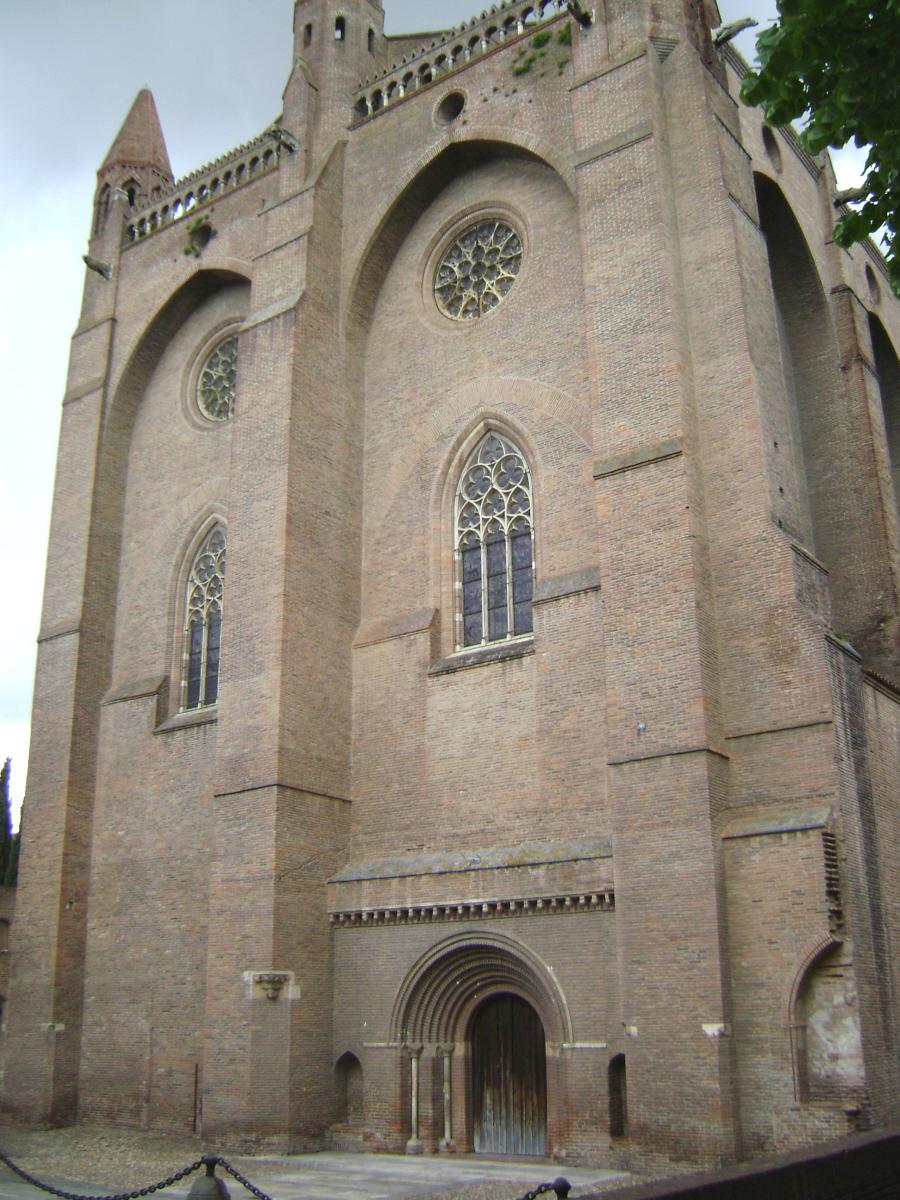
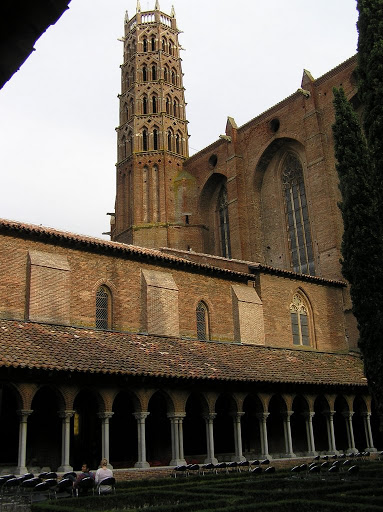
To the Église des Jacobins, Toulouse, France, in the year 1369.
View Larger Map
CHAPTER X: TRANSLATIONS OF HIS RELICS.
FROM the day of his departure, petitions were addressed to the Holy See for the privilege of possessing his incorrupt body: the King of Sicily and the Counts of Aquino and San Severino did so by title of kinship, the Universities of Paris and Naples by reason of his services rendered in life, and his own Order by right of sonship. The Cistercians of Fossa Nuova, however, kept their treasure for close upon a century; since their church had become a sanctuary renowned for miracles, they refused to part with what Providence had sent them.
In October, 1274, Abbot James and two monks secretly removed the body to St. Stephen's Chapel in the cloister, for which the saint rebuked them in a dream: incautiously they opened the coffin, whereupon a marvellous perfume exhaled which penetrated the cells and church, and the deceit practised was exposed. All saw him as if but reposing in sleep: as they carried him back to the church a marvellous light shone around. Abbot Peter translated the body to a befitting tomb in the choir in 1279, situated on the Gospel side of the high altar. The right hand, still perfectly intact and giving forth a delightful odour, was cut off in 1284 and bestowed on his sister the Countess of San Severino, who placed it in a silver reliquary: her son, Thomas, afterwards gave it to the Dominicans of Salerno.
 Early in the year 1304, in consequence of a report that Pope Benedict XI meant to restore the remains to the Friars Preachers, the Cistercians amputated the head and placed it in a tabernacle behind the choir; the body, still exhaling the same fragrance, they deposited in a massive chest for secret concealment. It was privately conveyed to the Chapel of the Count of Fondi, another kinsman of the holy Doctor. The Lord of Piperno, who was at feud with him, resolved on carrying off the treasure, so as to extort a heavy ransom. Philip, King of Sicily, now sent an embassy of bishops and nobles, together with a great donation of gold, in order to secure the holy remains, alleging his claim of descent from the Aquinos: but the Count of Fondi would not deliver them up. Years went past, until St. Thomas admonished the Count that his relics were not in their proper place. His mother, who had been healed at his intercession, was praying with the Bishop of Fondi before the great chest, when both beheld him emerge as a living man, and after walking for a short time in silence, laid himself down again to rest. In consequence of this, the Count resigned the body to the Dominicans of Fondi, who placed it in their church. Here, for the second time, St. Thomas came forth visibly before Father Raymund. The Cistercians addressed a complaint to Pope Urban V, who ordered an investigation to be made as to the respective claims of the two Orders; the rights of the Friars Preachers were warmly urged by the Queen of Sicily, the Count of Aquino, and the Dominican Cardinals. The Father General, Elias of Toulouse, then went direct to the Pope. "You come at the right time," said Urban; "it is you who stole the body of St. Thomas." "Holy Father," answered Elias, "he is our brother and our flesh."

 On 4 August, 1368, the head and body were laid in the papal chapel at Montefiascone, and solemnly delivered over to the Master General's keeping. The relics reposed for a month with the Dominican Sisters at Prouille, and many were the miracles wrought on the way. On 28 January, 1369, they were solemnly conveyed to the Dominican Church in Toulouse by Louis Duke of Anjou, many prelates, and a concourse of 150,000 persons. The festival of his Translation became a day of precept for the diocese. His right arm was bestowed on Paris University, and was placed by King Charles in the Dominican Church, in St. Thomas's Chapel; at the Great Revolution it was conveyed to Rome, and now rests in the Minerva Church. The chief bone of his left arm was given to his brethren in Naples, who transferred it to the Cathedral in 1603.
 In 1628 a magnificent shrine, with altars at the four sides, was erected in Toulouse. At the Great Revolution it was thrown down, and the remains, draped with the Republican flag, conveyed for safety by the Constitutional clergy to an obscure corner in St. Sernin's crypt. They were exposed for veneration in 1805; the sacred head was enclosed in a new reliquary in the year 1852. On 24 July, 1878, the Archbishop of Toulouse, Monseigneur Desprez, after judicial verification of the relics enclosed them in a superb sarcophagus of gold and silver.





.jpg)