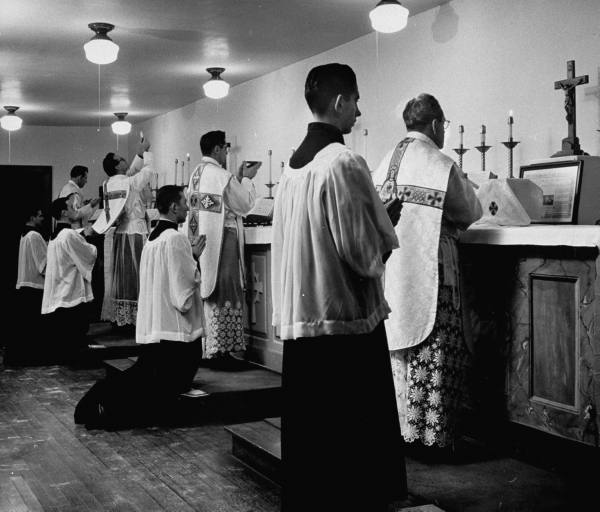
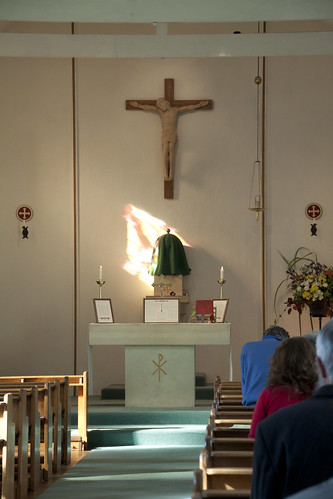
.jpg)



The following is a reply to a recent comment in my other blog, Willamette Valley Latin Mass Society. Please refer to that comment before reading this reply.
Since that other blog is mainly intended for the practical purpose of communicating Mass times for my local area, and since Blogger won't allow me to post such a long reply in the comments section anyway, I am posting it as an independent post here on Ite ad Thomam, where followers can continue the discussion.
Dear Fr. Jaspers,
 Thank you for your comment and for your opinion. Respectfully, here are my two cents as a private person, and a layman.
You are right: I decided to put the WVLMS page together, not to make a theological statement, but just to communicate the times and places of the Masses in question within the Willamette Valley. But now that you bring it up, I would like to take up this excellent opportunity to think about these issues more deeply together with you.
Of course, aside from any ideological consideration, to communicate Mass times for the ordo antiquus, I have to make a choice as to what to call it. Without a term, people have no way of knowing what I'm talking about. Naturally I have to decide on a term according to the custom of those who use the page, who are mostly people who are attached to it and who will travel long distances accross the Willammette Valley to attend these Masses. And given that I have several names as options, I have to use my theological reasoning and my conscience---which I have striven to inform according to Catholic teaching and sound theological reasoning---to decide which term is the best.
In trying to figure out what term to use, three main options come to mind: (1) "Tridentine Mass," (2) "Extraordinary Form (EF for short)," and (3) "Traditional Mass" or "Traditional Latin Mass (TLM)," and its variants. But I think the terms "Tridentine Mass" and "Extraordinary Form" are a bit unfortunate, for different reasons, which I will explain. I will also (4) address your comment that the novus ordo, too, is traditional, and (5) will make some concluding remarks.
(1) I think using the term "Tridentine Mass" is a disservice to the cause, in a way. One of the marvellous aspects of the ordo antiquus is its patristic origins: it connects us in a living way to our fathers in the faith, to the way they lived it. It was the Latin Church Fathers who bequeathed this amazing gift to us, and we see their stamp in the way we worship every Sunday in the ordo antiquus (or every day, in some parishes). But the "Tridentine Mass" terminology blurrs this reality and promotes the erroneous idea that the ordo antiquus can only be traced back to the liturgical reforms after the Council of Trent (16th century), and that before then the Roman Rite was substantially different, and that therefore the current rite that we know as the "Tridentine Mass" has relatively modern origins. If anything it would have to be called the "Gregorian Mass" to indicate that it is much older and can be traced at least as far back as St. Gregory the Great (6th cent.), just like we say "Gregorian Chant" to indicate the Latin Patristic origins of the music that belongs to that Rite. That terminology would also mirror our Byzantine brothers and sisters who have the Liturgy of St. Basil, the Liturgy of St. John Chrysostom, etc. I would in fact prefer the terminology of the "Gregorian Mass", but alas, it is not a very common or accepted terminology, and it is in fact already used to refer to something else (the 30 Gregorian Masses devotion).
(2) As far as 'Extraordinary Form' (which, of course, is one of Pope Benedict's many terminologies to resolve a canonical problem, never intended to be the single, official name for the rite), I have two issues with it: I am (a) a bit uncomfortable with it, to be frank, and (b) I think it is not broad enough to encompass what we are announcing. The reason I am (a) uncomfortable with it is not that I think it is wrong, or that it implies something false. Rather, I am slightly uncomfortable with it because it misses the essence of what it describes. It is very much a relative term that does not signify its referent on the basis of its own nature but on account of a historical accident: if the antiquus ordo happens to be extraordinary, it is only because at this moment in history the novus ordo is more common or ordinary (and that is accidental to its nature). For most of Church history it was the ordo antiquus which has been the ordinary form. And in fact, I pray that someday, hopefully sooner rather than later, it is the antiquus ordo which is considered the ordinary form again, leaving the novus ordo as something very much extraordinary. If that were to happen, centuries down the road, this century will be but a mere hiccup in the history of the Roman Rite, a strange time when Roman Catholics momentarily forgot how they ordinarily worshipped throughout history. To put it differently, for traditional Catholics to call it the 'Extraordinary Form' would be analogous to starting a political party and calling it the 'Minority Party'. Not only would it defeat the whole goal of the cause being promoted, but actually the name would fail to capture the essence of the thing named. I do not usually object to someone using this term (since it comes from the Pope), but I do not prefer it and I do not use it myself normally.
And (b), the term 'EF' is too narrow, and not broad enough to encompass the other Latin rites. In fact, one of the churches that commonly has Massses that are of our interest is Holy Rosary Parish, in Portland, where the Dominicans have several Dominican Rite Masses every month. These Masses are not technically in the EF, because that term applies exclusively to the Roman Rite, as per Summorum Pontificum. Rather, the Dominican Rite has no extraordinary form. The Dominican Rite has only an ordinary form which has remained substantially unchanged throughout its history and has not been touched by the recent liturgical reform. So if we were to announce only "EF Masses" we would be leaving out these Dominican Rite Masses, which are of interest to the TLM community in our area.
(3) So it is mainly because of these reservations (which I believe are shared by many TLM communities), I naturally lean towards using the term TLM as the normal way to refer to the ordo antiquus. But besides the fact that the other alternatives are not good choices, I think the primary reason for using this term is that in itself it is clear enough simply because it is the way most people have referred to it in actual practice, at least in my experience in the last 15 years attending the old rite in the USA, Canada, Mexico, and Europe. It is the term ordinarily given to the ordo antiquus by traditional Catholics. (And by 'traditional Catholics' I mean those of us who are attached in an exclusive way to the ordo antiquus and the mode of thinking surrounding it, and who are steeped in it enough to let it be the basis of their faith in an exclusive, or nearly exclusive way.) See for example the terminology used in websites such as Coalition in Support of Ecclesia Dei: Promoting the Traditional Latin Mass as sanctioned by Summorum Pontificum, and its widely-used Directory of Latin Masses, as well as the normal terminology in the popular blog "Rorate Caeli," and specifically its discussion on this very issue of the terminology of the ordo antiquus. It is the way it is called in the most widely-used Latin-English missalette (see picture above), and it is the way it is called by most members of the Priestly Fraternity of St. Peter, the Institute of Christ the King, and similar orders who are devoted to the ordo antiquus and who celebrate the vast majority of Masses in the ordo antiquus. So it is safe to say that I can hardly be blamed for doing the same. In fact, no one who regularly uses the information on the site---which is usually traditinal Catholics who are willing to travel throughout the Willamette Valley to attend one of these Masses---have so much as hinted to me that there might be a problem with the term. However, in conversation and in print I have become aware of many objections regarding the other terms.
(4) Now, I must confess I was a bit surprised by your comment that the novus ordo, too, is traditional (and not just the ordo antiquus). I think we must make distinctions here. In all philosophical objectivity, we have to recognize that the term 'traditional' is very much an analogical term. It obviously does not mean the same thing when I say that the ordo antiquus is 'traditional' as when you say the novus ordo is 'traditional'.
The ordo antiquus is traditional because it is the form of worship that Roman Catholics have been 'handing down' from generation to generation for nearly two millenia. This is the way the vast majority of popes and saints in our calendar have worshipped. St. Jerome, St. Gregory, St. Leo, St. Isidore, St. Anselm, St. Bernard, St. Francis, St. Thomas, St. Catherine, St. Pius V, St. Ignatius, St. Frances, St. Joan of Arc, St. Teresa of Avila, St. Alphonsus, St. Margaret Mary, St. John Bosco, St. Therese, St. Pius X, St. Josemaria, just to mention a few, all worshipped according to the ordo antiquus (even if in the various Latin rites), and their faith was formed exclusively by it. Hence, it is in the strong sense that the ordo antiquus can be called the TLM, since it refers to the Mass according to the tradition of the Latin Rites.
But the novus ordo is not 'traditional' in the sense that the ordo antiquus is traditional. It is quite discontinuous with the tradition of the Latin Rites; a careful comparison of the prayers (and options) illustrates this amply. So if for the sake of argument we grant that the novus ordo is 'traditional', to make that a true statement we would have to change the meaning of 'traditional'. But that meaning would definitely not be the normal use of the term, the sense in which most people use it.
To be clear, here I am simply making a descriptive claim, and not a normative one. I am simply observing that the novus ordo is a significant departure from what has been handed down to us from time immemorial. So it cannot be called 'traditional' in the sense in which the ordo antiquus is traditional. I'm not saying that "the present Order of the Mass is an abomination" or anything of the sort. And I actually admire you for your courage in saying the novus ordo in Latin in this diocese; may God reward you for that. But obviously, you would agree that if you were to celebrate a novus ordo Mass in Latin and called it the "Traditional Latin Mass," and advertized it as a TLM (without telling people you really mean the novus ordo), you would really be confusing them and even disappointing many, because that is not what everyone understands by that term.
(5) So, to summarize, since the other terms are not satisfactory, and since no one (rightly) thinks of the novus ordo as being traditional, at least not in the strong sense in which the ordo antiquus is traditional, and since most people who really care about it call it the TLM anyway, it seemed to me to be a sufficient and adquate term and to be preferable over all the others. I do not usually object when people use the other terms, but I myself prefer TLM.
But ultimately, Father, I think you are right in saying that language matters, and in pointing out that the term "Traditional Latin Mass" is not perfect. I would agree that it is not totally unambiguous. And I would even grant that the particular variant "Latin Mass" is indeed very ambiguous. In fact, given these reflections, I might therefore change the name of the site from "Willamette Valley Latin Mass Society" to "Willamette Valley Traditional Mass Society," or something like it. I will pray about it.
But ultimately, Father, I think you are right in saying that language matters, and in pointing out that the term "Traditional Latin Mass" is not perfect. I would agree that it is not totally unambiguous. And I would even grant that the particular variant "Latin Mass" is indeed very ambiguous. In fact, given these reflections, I might therefore change the name of the site from "Willamette Valley Latin Mass Society" to "Willamette Valley Traditional Mass Society," or something like it. I will pray about it.
But these, dear Father, are just my personal convictions. I appreciate the opportunity to discuss these issues with you, and look forward to your feedback. I wish you many blessings in your ministry. I said a memorare for the victims in Roseburg and hope that our readers do the same. Perhaps you can offer an old requiem Mass for them. I would be happy to serve.
In Christo rege,
Dr. Francisco Romero Carrasquillo